

Original: Geoffrey Huntley · 09/09/2025
Summary
If you’re using AI only to “do” and not “learn”, you are missing out It’s a strange feeling knowing that you can create anything, and I’m starting to wonder if there’s a seventh stage to the “people stages of AI adoption by software developers”Key Insights
“If you’re using AI only to “do” and not “learn”, you are missing out” — Highlighting the importance of learning from AI, not just using it to automate tasks.
“The programming language is called ‘cursed’. It’s cursed in its lexical structure, it’s cursed in how it was built.” — Describing the unique and challenging aspects of the new programming language.
“Anything that Claude thought was appropriate to add.” — Explaining the autonomous and creative freedom given to Claude in developing the language.
Topics
Full Article
i ran Claude in a loop for three months, and it created a genz programming language called cursed
Author: Geoffrey HuntleyPublished: 2025-09-09
Source: https://ghuntley.com/cursed/
It’s a strange feeling knowing that you can create anything, and I’m starting to wonder if there’s a seventh stage to the “people stages of AI adoption by software developers”
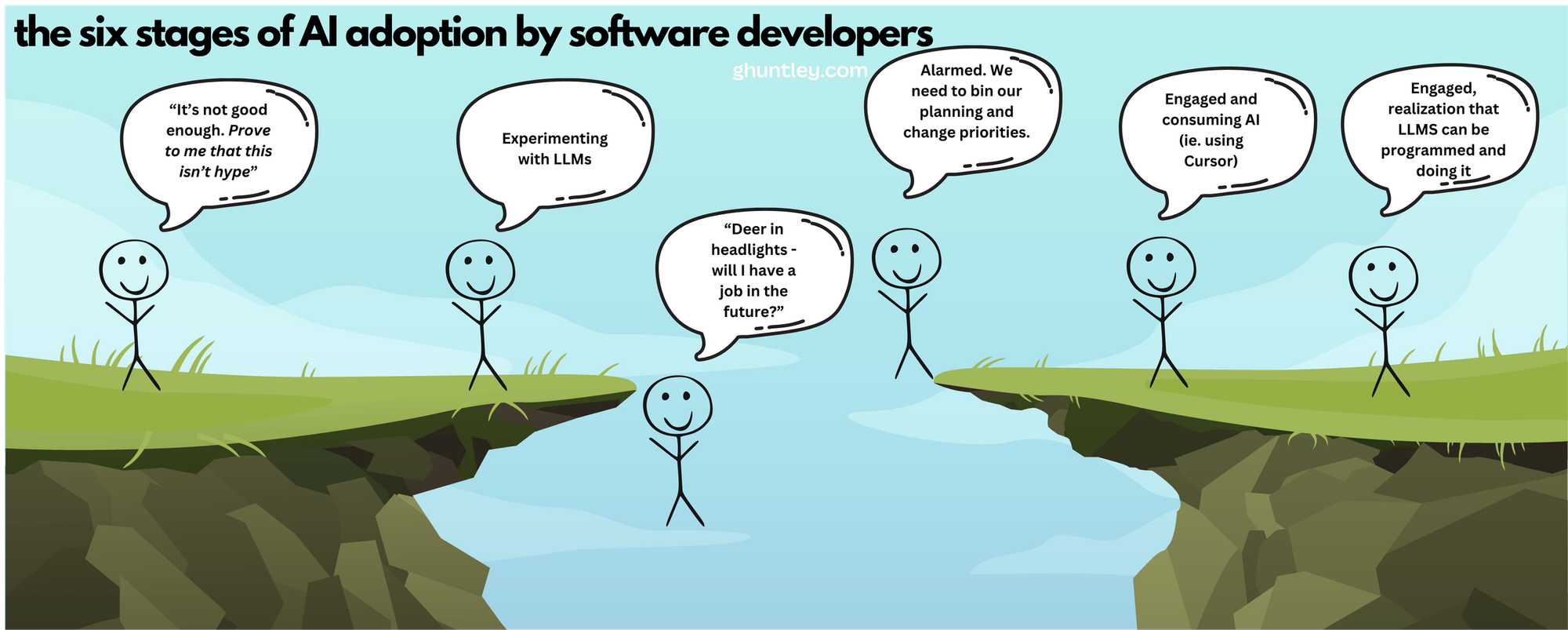 whereby that seventh stage is essentially this scene in the matrix…
▶ The Matrix - ‘I Know Kung Fu’
It’s where you deeply understand that ‘you can now do anything’ and just start doing it because it’s possible and fun, and doing so is faster than explaining yourself. Outcomes speak louder than words.
There’s a falsehood that AI results in SWE’s skill atrophy, and there’s no learning potential.
whereby that seventh stage is essentially this scene in the matrix…
▶ The Matrix - ‘I Know Kung Fu’
It’s where you deeply understand that ‘you can now do anything’ and just start doing it because it’s possible and fun, and doing so is faster than explaining yourself. Outcomes speak louder than words.
There’s a falsehood that AI results in SWE’s skill atrophy, and there’s no learning potential.
If you’re using AI only to “do” and not “learn”, you are missing outI’ve never written a compiler, yet I’ve always wanted to do one, so I’ve been working on one for the last three months by running Claude in a while true loop (aka “Ralph Wiggum”) with a simple prompt:
Hey, can you make me a programming language like Golang but all the lexical keywords are swapped so they’re Gen Z slang?Why? I really don’t know. But it exists. And it produces compiled programs. During this period, Claude was able to implement anything that Claude desired. The programming language is called “cursed”. It’s cursed in its lexical structure, it’s cursed in how it was built, it’s cursed that this is possible, it’s cursed in how cheap this was, and it’s cursed through how many times I’ve sworn at Claude.
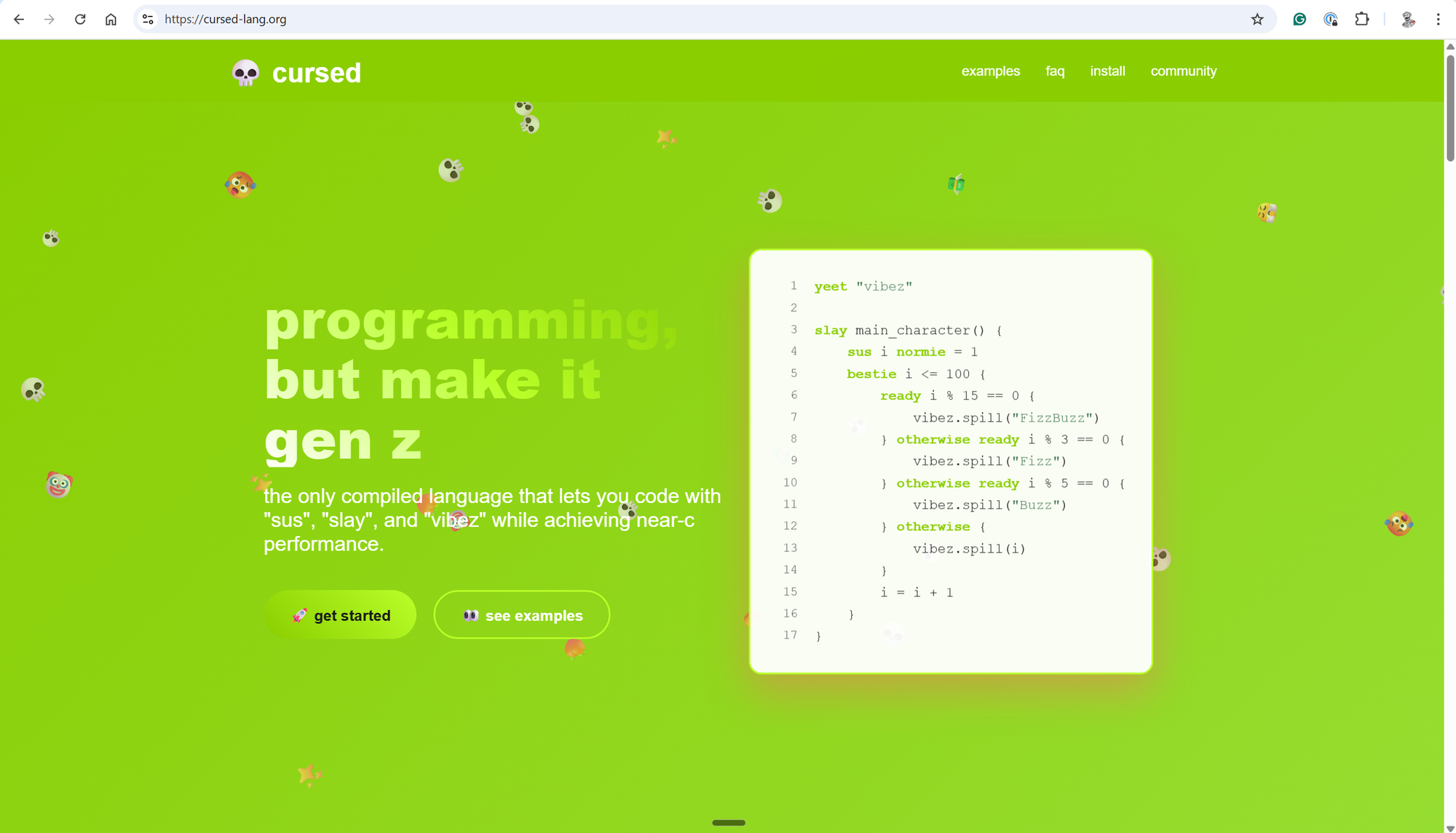 https://cursed-lang.org/
For the last three months, Claude has been running in this loop with a single goal:
https://cursed-lang.org/
For the last three months, Claude has been running in this loop with a single goal:
“Produce me a Gen-Z compiler, and you can implement anything you like.”It’s now available at:
the 💀 cursed programming language: programming, but make it gen z — 💀 cursed
GitHub - ghuntley/cursed: the 💀 cursed programming language: programming, but make it gen z the 💀 cursed programming language: programming, but make it gen z - ghuntley/cursed — GitHub
whats included?
Anything that Claude thought was appropriate to add. Currently…- The compiler has two modes: interpreted mode and compiled mode. It’s able to produce binaries on Mac OS, Linux, and Windows via LLVM.
- There are some half-completed VSCode, Emacs, and Vim editor extensions, and a Treesitter grammar.
- A whole bunch of really wild and incomplete standard library packages.
lexical structure
Control Flow:ready → if
otherwise → else
bestie → for
periodt → while
vibe_check → switch
mood → case
basic → default
Declaration:
vibe → package
yeet → import
slay → func
sus → var
facts → const
be_like → type
squad → struct
Flow Control:
damn → return
ghosted → break
simp → continue
later → defer
stan → go
flex → range
Values & Types:
based → true
cringe → false
nah → nil
normie → int
tea → string
drip → float
lit → bool
ඞT (Amogus) → pointer to type T
Comments:
fr fr → line comment
no cap...on god → block comment
example program
Here is leetcode 104 - maximum depth for a binary tree:study specs/* to learn about the programming language. When authoring the cursed standard library think extra extra hard as the CURSED programming language is not in your training data set and may be invalid. Come up with a plan to implement XYZ as markdown then do itThere is no roadmap; the roadmap is whatever the community decides to ship from this point forward. At this point, I’m pretty much convinced that any problems found in cursed can be solved by just running more Ralph loops by skilled operators (ie. people with experience with compilers who shape it through prompts from their expertise vs letting Claude just rip unattended). There’s still a lot to be fixed, happy to take pull-requests.
Ralph Wiggum as a “software engineer” 😎Here’s a cool little field report from a Y Combinator hackathon event where they put Ralph Wiggum to the test. “We Put a Coding Agent in a While Loop and It Shipped 6 Repos Overnight” https://github… — Geoffrey Huntley
LLMs are mirrors of operator skill This is a follow-up from my previous blog post: “deliberate intentional practice”. I didn’t want to get into the distinction between skilled and unskilled because people take offence to it, but AI is … — Geoffrey HuntleySuccess is defined as cursed ending up in the Stack Overflow developer survey as either the “most loved” or “most hated” programming language, and continuing the work to bootstrap the compiler to be written in cursed itself. Cya soon in Discord? - https://discord.gg/CRbJcKaGNT ▶ Claude made its own language (it took 3 months)
the 💀 cursed programming language: programming, but make it gen z — 💀 cursed
GitHub - ghuntley/cursed: the 💀 cursed programming language: programming, but make it gen z the 💀 cursed programming language: programming, but make it gen z - ghuntley/cursed — GitHubps. socials
I ran Claude in a loop for 3 months and created a brand new “GenZ” programming language. It’s called @cursedlang. v0.0.1 is now available, and the website is ready to go. Details below! pic.twitter.com/Ku5kbWMRgR — geoff (@GeoffreyHuntley) September 9, 2025
Key Takeaways
Notable Quotes
If you’re using AI only to “do” and not “learn”, you are missing outContext: Highlighting the importance of learning from AI, not just using it to automate tasks.
The programming language is called ‘cursed’. It’s cursed in its lexical structure, it’s cursed in how it was built.Context: Describing the unique and challenging aspects of the new programming language.
Anything that Claude thought was appropriate to add.Context: Explaining the autonomous and creative freedom given to Claude in developing the language.
Related Topics
- [[topics/openai-api]]
- [[topics/claude-code]]
- [[topics/prompt-engineering]]
Related Articles
Building a C compiler with a team of parallel Claudes
Anthropic Engineering · explanation · 75% similar
Ralph Wiggum as a "software engineer"
Geoffrey Huntley · explanation · 73% similar
everything is a ralph loop
Geoffrey Huntley · explanation · 73% similar
Originally published at https://ghuntley.com/cursed/.