

Original: Anthropic Engineering · 21/02/2026
Summary
For an AI model to be useful in specific contexts, it often needs access to background knowledge. For an AI model to be useful in specific contexts, it often needs access to background knowledge.Key Insights
“For an AI model to be useful in specific contexts, it often needs access to background knowledge.” — Explaining the necessity of background knowledge for AI models.
“Contextual Retrieval can reduce the number of failed retrievals by 49%.” — Highlighting the effectiveness of Contextual Retrieval.
“Sometimes the simplest solution is the best.” — Discussing the approach of using longer prompts for smaller knowledge bases.
Topics
Full Article
Introducing Contextual Retrieval
Author: Anthropic EngineeringPublished: 2026-02-21
Source: https://www.anthropic.com/engineering/contextual-retrieval
Engineering at Anthropic

Introducing Contextual Retrieval
Published Sep 19, 2024 For an AI model to be useful in specific contexts, it often needs access to background knowledge. For an AI model to be useful in specific contexts, it often needs access to background knowledge. For example, customer support chatbots need knowledge about the specific business they’re being used for, and legal analyst bots need to know about a vast array of past cases. Developers typically enhance an AI model’s knowledge using Retrieval-Augmented Generation (RAG). RAG is a method that retrieves relevant information from a knowledge base and appends it to the user’s prompt, significantly enhancing the model’s response. The problem is that traditional RAG solutions remove context when encoding information, which often results in the system failing to retrieve the relevant information from the knowledge base. In this post, we outline a method that dramatically improves the retrieval step in RAG. The method is called “Contextual Retrieval” and uses two sub-techniques: Contextual Embeddings and Contextual BM25. This method can reduce the number of failed retrievals by 49% and, when combined with reranking, by 67%. These represent significant improvements in retrieval accuracy, which directly translates to better performance in downstream tasks. You can easily deploy your own Contextual Retrieval solution with Claude with our cookbook.A note on simply using a longer prompt
Sometimes the simplest solution is the best. If your knowledge base is smaller than 200,000 tokens (about 500 pages of material), you can just include the entire knowledge base in the prompt that you give the model, with no need for RAG or similar methods. A few weeks ago, we released prompt caching for Claude, which makes this approach significantly faster and more cost-effective. Developers can now cache frequently used prompts between API calls, reducing latency by > 2x and costs by up to 90% (you can see how it works by reading our prompt caching cookbook). However, as your knowledge base grows, you’ll need a more scalable solution. That’s where Contextual Retrieval comes in.A primer on RAG: scaling to larger knowledge bases
For larger knowledge bases that don’t fit within the context window, RAG is the typical solution. RAG works by preprocessing a knowledge base using the following steps:- Break down the knowledge base (the “corpus” of documents) into smaller chunks of text, usually no more than a few hundred tokens;
- Use an embedding model to convert these chunks into vector embeddings that encode meaning;
- Store these embeddings in a vector database that allows for searching by semantic similarity.
- Break down the knowledge base (the “corpus” of documents) into smaller chunks of text, usually no more than a few hundred tokens;
- Create TF-IDF encodings and semantic embeddings for these chunks;
- Use BM25 to find top chunks based on exact matches;
- Use embeddings to find top chunks based on semantic similarity;
- Combine and deduplicate results from (3) and (4) using rank fusion techniques;
- Add the top-K chunks to the prompt to generate the response.
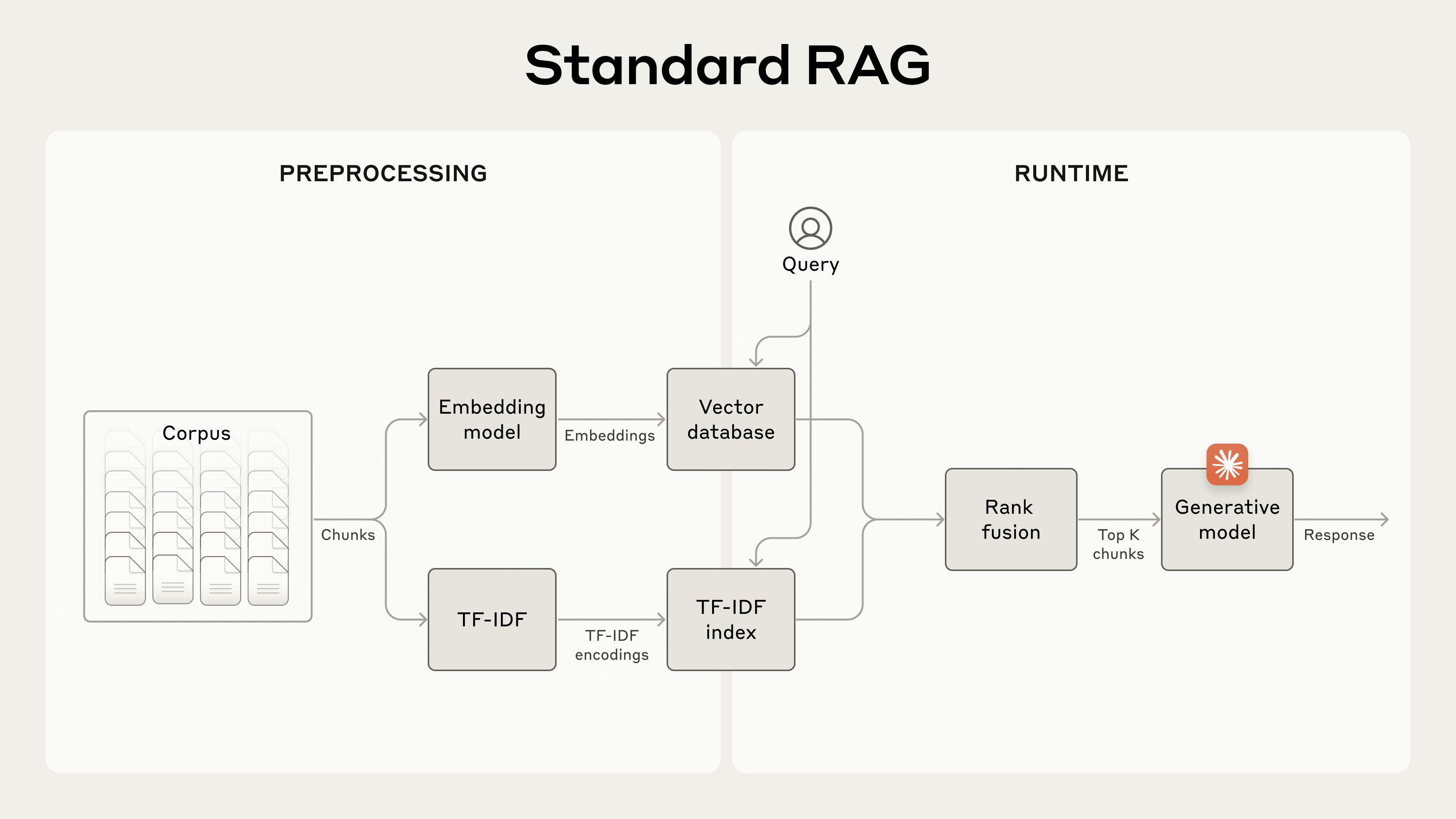 A Standard Retrieval-Augmented Generation (RAG) system that uses both embeddings and Best Match 25 (BM25) to retrieve information. TF-IDF (term frequency-inverse document frequency) measures word importance and forms the basis for BM25.
This approach allows you to cost-effectively scale to enormous knowledge bases, far beyond what could fit in a single prompt. But these traditional RAG systems have a significant limitation: they often destroy context.
A Standard Retrieval-Augmented Generation (RAG) system that uses both embeddings and Best Match 25 (BM25) to retrieve information. TF-IDF (term frequency-inverse document frequency) measures word importance and forms the basis for BM25.
This approach allows you to cost-effectively scale to enormous knowledge bases, far beyond what could fit in a single prompt. But these traditional RAG systems have a significant limitation: they often destroy context.
The context conundrum in traditional RAG
In traditional RAG, documents are typically split into smaller chunks for efficient retrieval. While this approach works well for many applications, it can lead to problems when individual chunks lack sufficient context. For example, imagine you had a collection of financial information (say, U.S. SEC filings) embedded in your knowledge base, and you received the following question: “What was the revenue growth for ACME Corp in Q2 2023?” A relevant chunk might contain the text: “The company’s revenue grew by 3% over the previous quarter.” However, this chunk on its own doesn’t specify which company it’s referring to or the relevant time period, making it difficult to retrieve the right information or use the information effectively.Introducing Contextual Retrieval
Contextual Retrieval solves this problem by prepending chunk-specific explanatory context to each chunk before embedding (“Contextual Embeddings”) and creating the BM25 index (“Contextual BM25”). Let’s return to our SEC filings collection example. Here’s an example of how a chunk might be transformed:Implementing Contextual Retrieval
Of course, it would be far too much work to manually annotate the thousands or even millions of chunks in a knowledge base. To implement Contextual Retrieval, we turn to Claude. We’ve written a prompt that instructs the model to provide concise, chunk-specific context that explains the chunk using the context of the overall document. We used the following Claude 3 Haiku prompt to generate context for each chunk: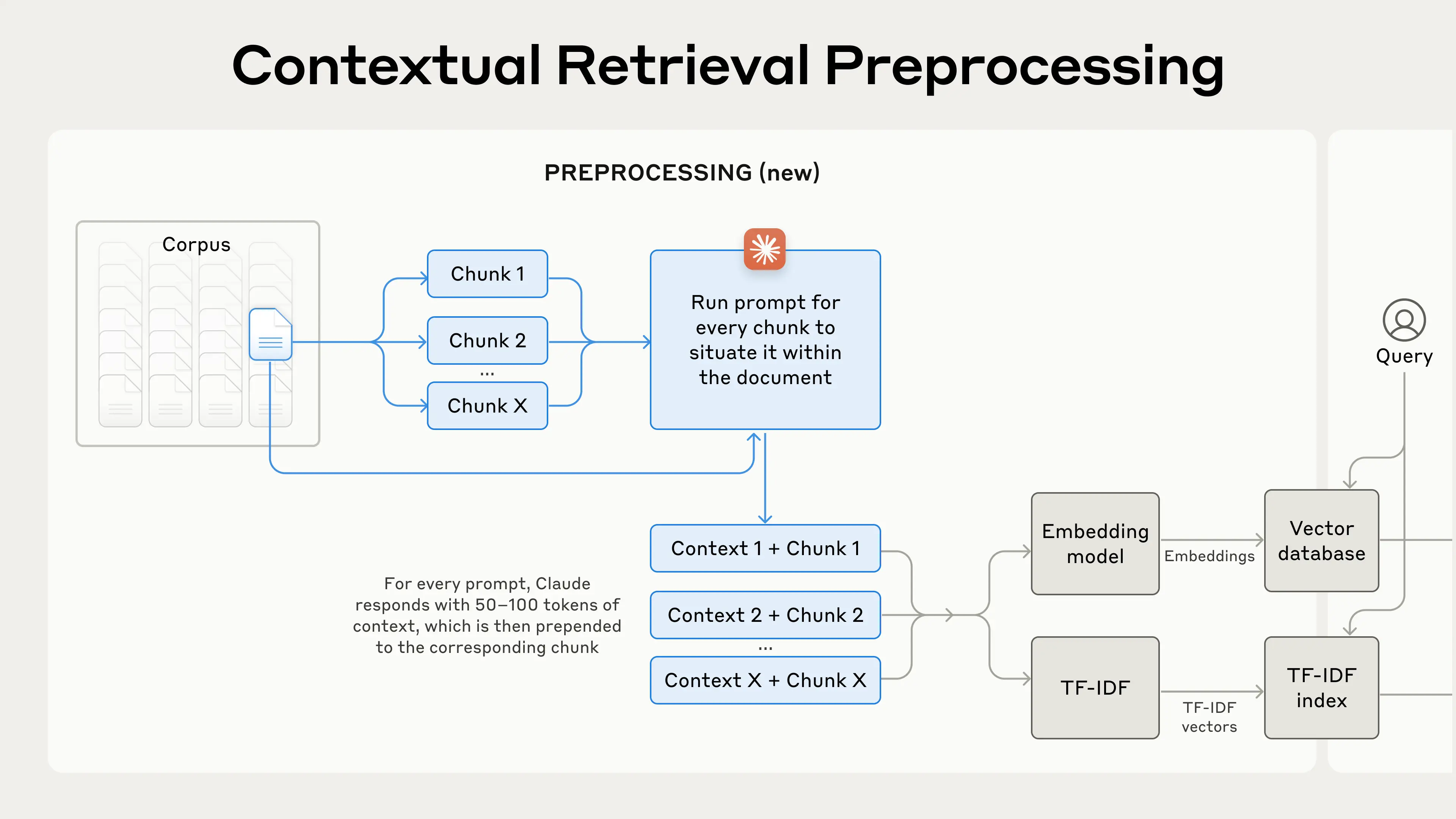 Contextual Retrieval is a preprocessing technique that improves retrieval accuracy.
If you’re interested in using Contextual Retrieval, you can get started with our cookbook.
Contextual Retrieval is a preprocessing technique that improves retrieval accuracy.
If you’re interested in using Contextual Retrieval, you can get started with our cookbook.
Using Prompt Caching to reduce the costs of Contextual Retrieval
Contextual Retrieval is uniquely possible at low cost with Claude, thanks to the special prompt caching feature we mentioned above. With prompt caching, you don’t need to pass in the reference document for every chunk. You simply load the document into the cache once and then reference the previously cached content. Assuming 800 token chunks, 8k token documents, 50 token context instructions, and 100 tokens of context per chunk, the one-time cost to generate contextualized chunks is $1.02 per million document tokens.Methodology
We experimented across various knowledge domains (codebases, fiction, ArXiv papers, Science Papers), embedding models, retrieval strategies, and evaluation metrics. We’ve included a few examples of the questions and answers we used for each domain in Appendix II. The graphs below show the average performance across all knowledge domains with the top-performing embedding configuration (Gemini Text 004) and retrieving the top-20-chunks. We use 1 minus recall@20 as our evaluation metric, which measures the percentage of relevant documents that fail to be retrieved within the top 20 chunks. You can see the full results in the appendix - contextualizing improves performance in every embedding-source combination we evaluated.Performance improvements
Our experiments showed that:- Contextual Embeddings reduced the top-20-chunk retrieval failure rate by 35% (5.7% → 3.7%).
- Combining Contextual Embeddings and Contextual BM25 reduced the top-20-chunk retrieval failure rate by 49% (5.7% → 2.9%).
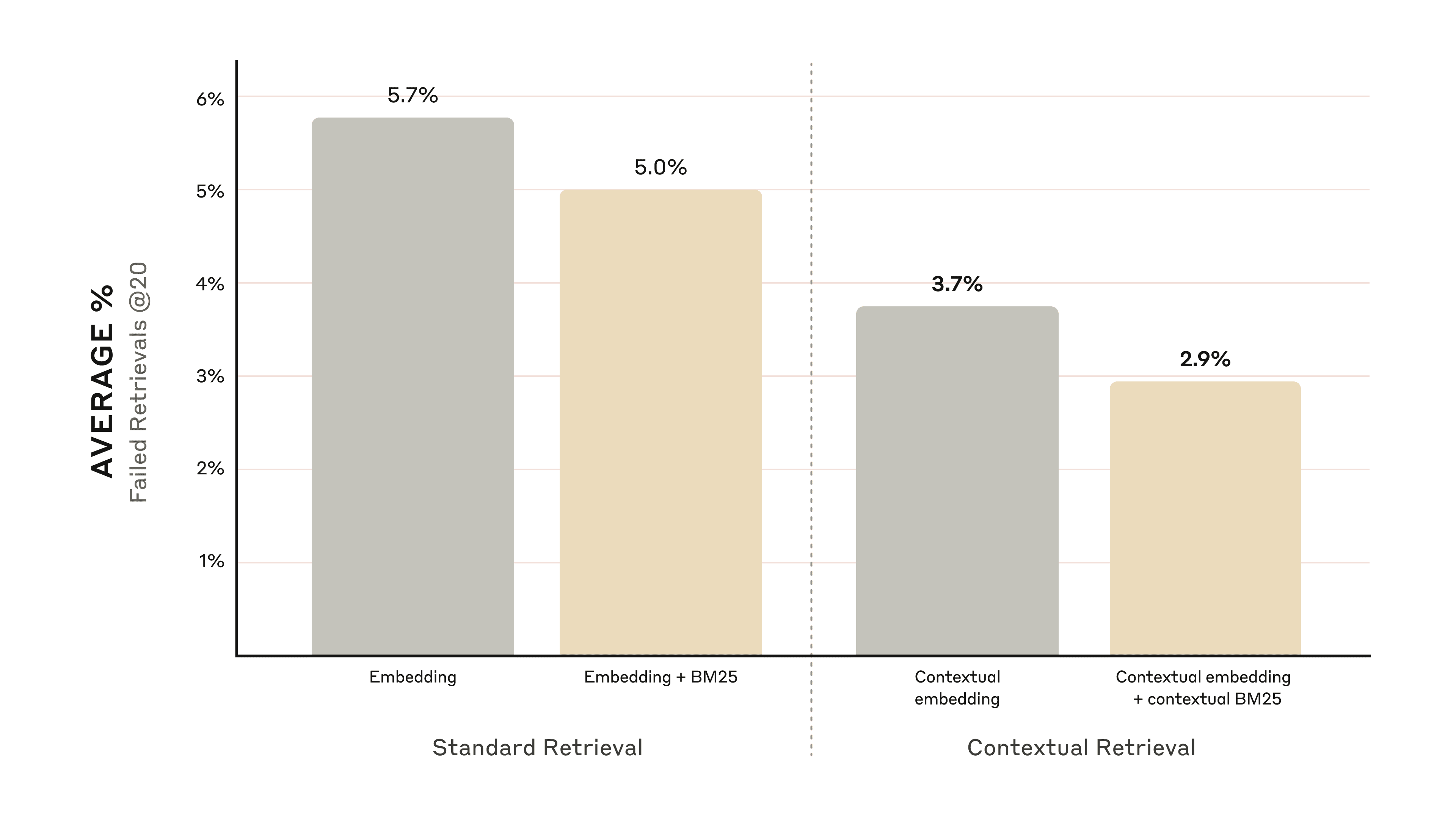 Combining Contextual Embedding and Contextual BM25 reduce the top-20-chunk retrieval failure rate by 49%.
Implementation considerations
When implementing Contextual Retrieval, there are a few considerations to keep in mind:- Chunk boundaries: Consider how you split your documents into chunks. The choice of chunk size, chunk boundary, and chunk overlap can affect retrieval performance1.
- Embedding model: Whereas Contextual Retrieval improves performance across all embedding models we tested, some models may benefit more than others. We found Gemini and Voyage embeddings to be particularly effective.
- Custom contextualizer prompts: While the generic prompt we provided works well, you may be able to achieve even better results with prompts tailored to your specific domain or use case (for example, including a glossary of key terms that might only be defined in other documents in the knowledge base).
- Number of chunks: Adding more chunks into the context window increases the chances that you include the relevant information. However, more information can be distracting for models so there’s a limit to this. We tried delivering 5, 10, and 20 chunks, and found using 20 to be the most performant of these options (see appendix for comparisons) but it’s worth experimenting on your use case.
Further boosting performance with Reranking
In a final step, we can combine Contextual Retrieval with another technique to give even more performance improvements. In traditional RAG, the AI system searches its knowledge base to find the potentially relevant information chunks. With large knowledge bases, this initial retrieval often returns a lot of chunks—sometimes hundreds—of varying relevance and importance. Reranking is a commonly used filtering technique to ensure that only the most relevant chunks are passed to the model. Reranking provides better responses and reduces cost and latency because the model is processing less information. The key steps are:- Perform initial retrieval to get the top potentially relevant chunks (we used the top 150);
- Pass the top-N chunks, along with the user’s query, through the reranking model;
- Using a reranking model, give each chunk a score based on its relevance and importance to the prompt, then select the top-K chunks (we used the top 20);
- Pass the top-K chunks into the model as context to generate the final result.
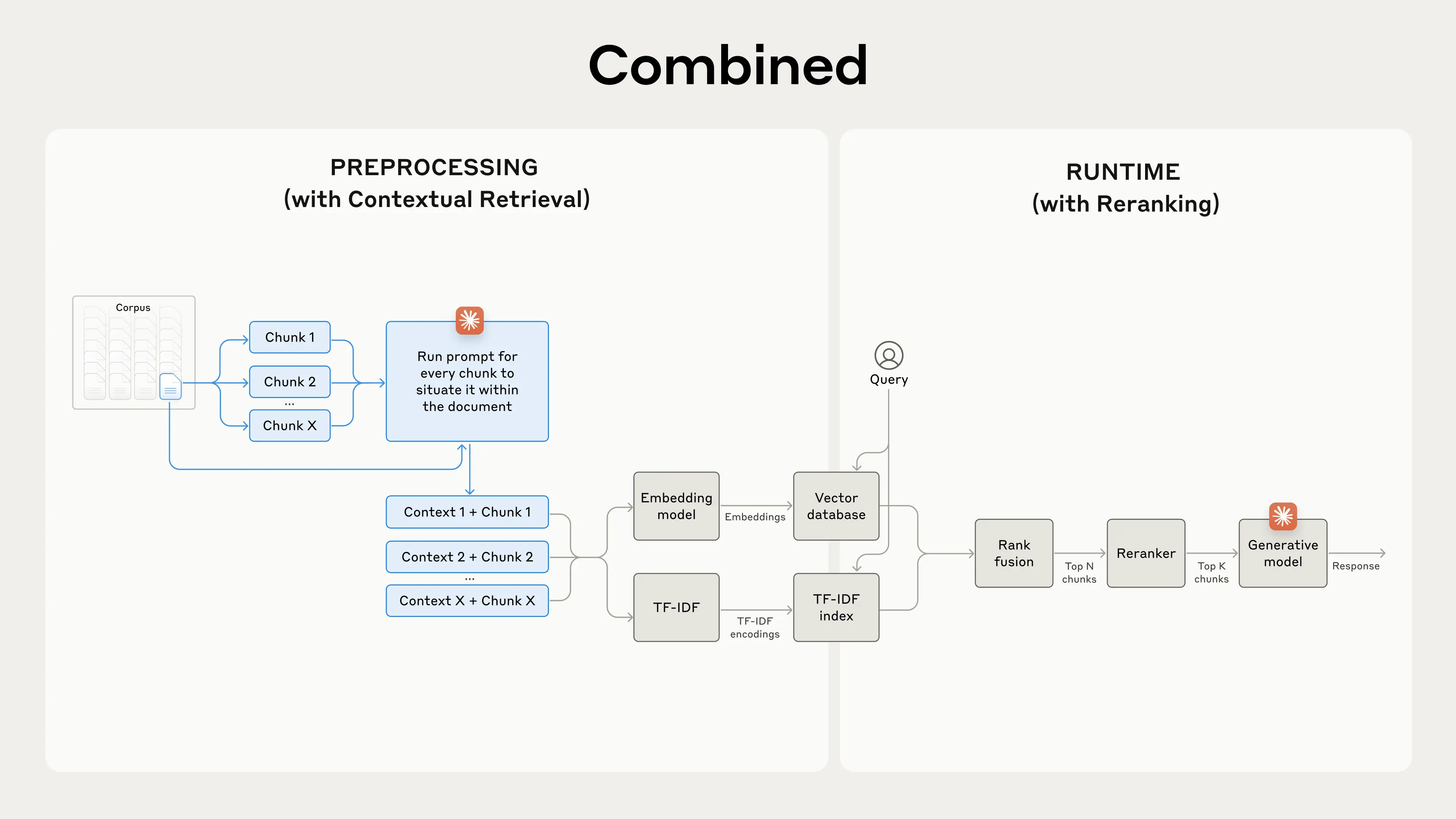 Combine Contextual Retrieva and Reranking to maximize retrieval accuracy.
Performance improvements
There are several reranking models on the market. We ran our tests with the Cohere reranker. Voyage also offers a reranker, though we did not have time to test it. Our experiments showed that, across various domains, adding a reranking step further optimizes retrieval. Specifically, we found that Reranked Contextual Embedding and Contextual BM25 reduced the top-20-chunk retrieval failure rate by 67% (5.7% → 1.9%).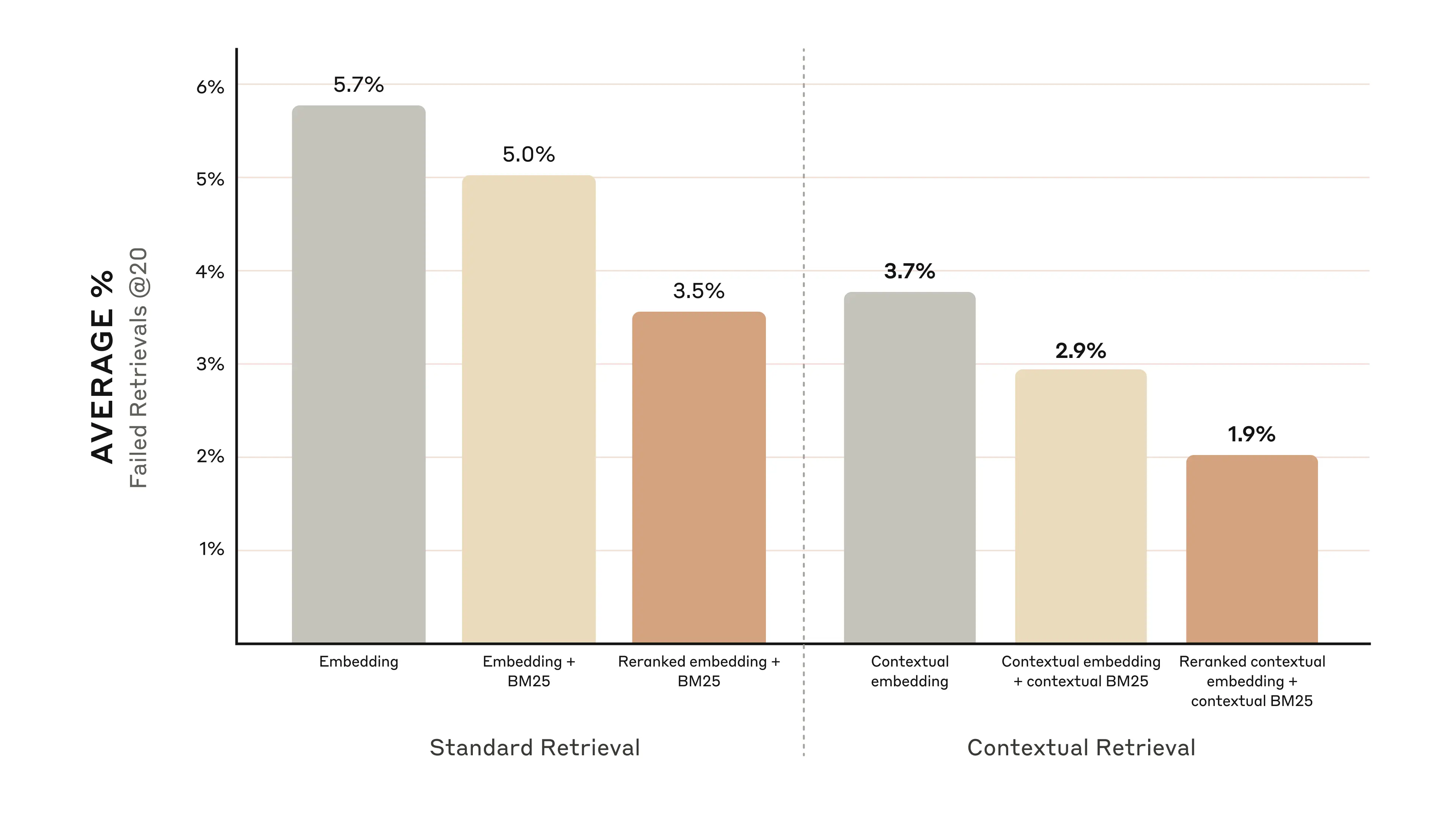 Reranked Contextual Embedding and Contextual BM25 reduces the top-20-chunk retrieval failure rate by 67%.
Cost and latency considerations
One important consideration with reranking is the impact on latency and cost, especially when reranking a large number of chunks. Because reranking adds an extra step at runtime, it inevitably adds a small amount of latency, even though the reranker scores all the chunks in parallel. There is an inherent trade-off between reranking more chunks for better performance vs. reranking fewer for lower latency and cost. We recommend experimenting with different settings on your specific use case to find the right balance.Conclusion
We ran a large number of tests, comparing different combinations of all the techniques described above (embedding model, use of BM25, use of contextual retrieval, use of a reranker, and total # of top-K results retrieved), all across a variety of different dataset types. Here’s a summary of what we found:- Embeddings+BM25 is better than embeddings on their own;
- Voyage and Gemini have the best embeddings of the ones we tested;
- Passing the top-20 chunks to the model is more effective than just the top-10 or top-5;
- Adding context to chunks improves retrieval accuracy a lot;
- Reranking is better than no reranking;
- All these benefits stack: to maximize performance improvements, we can combine contextual embeddings (from Voyage or Gemini) with contextual BM25, plus a reranking step, and adding the 20 chunks to the prompt.
Appendix I
Below is a breakdown of results across datasets, embedding providers, use of BM25 in addition to embeddings, use of contextual retrieval, and use of reranking for Retrievals @ 20. See Appendix II for the breakdowns for Retrievals @ 10 and @ 5 as well as example questions and answers for each dataset.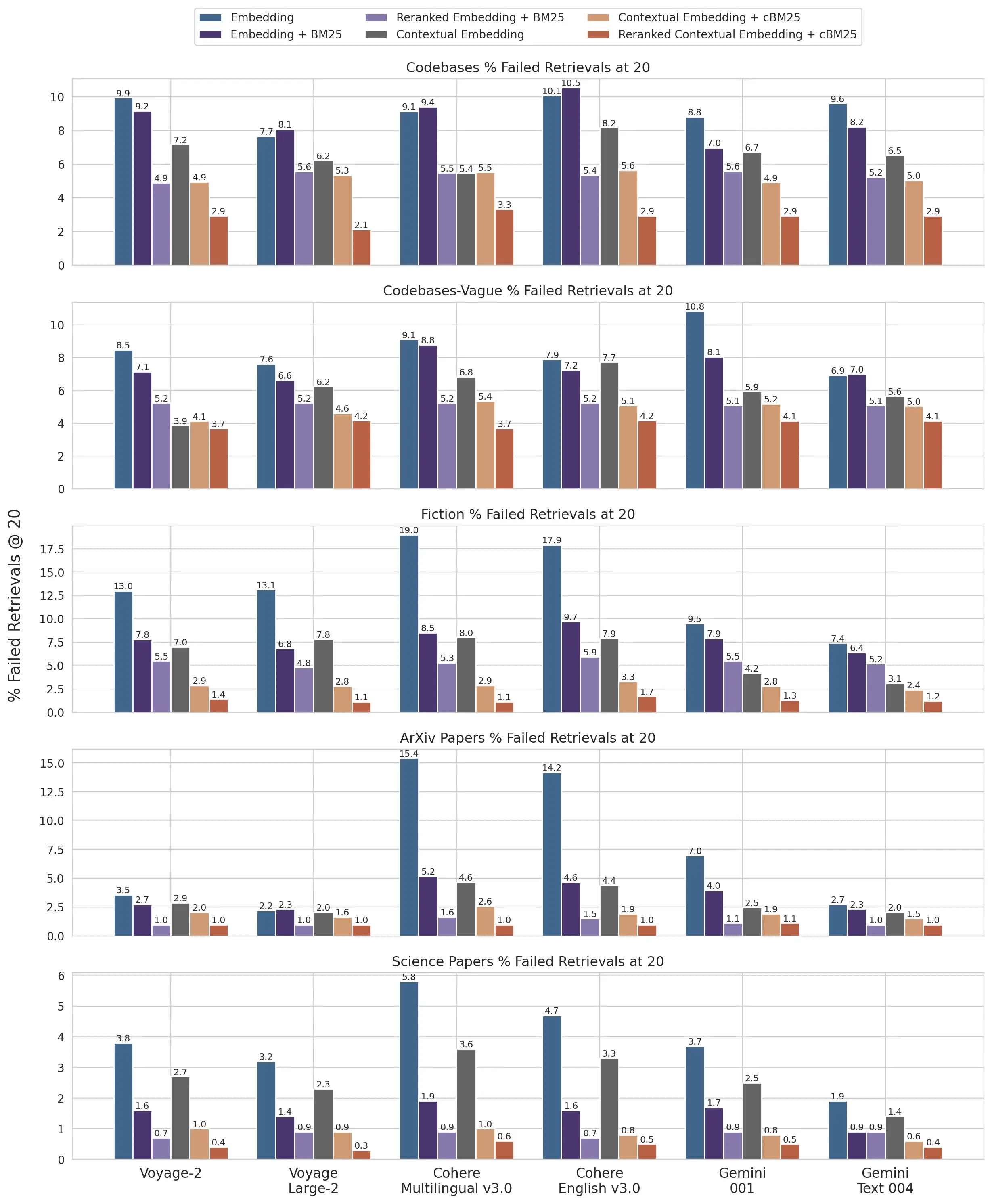 1 minus recall @ 20 results across data sets and embedding providers.
Acknowledgements
Research and writing by Daniel Ford. Thanks to Orowa Sikder, Gautam Mittal, and Kenneth Lien for critical feedback, Samuel Flamini for implementing the cookbooks, Lauren Polansky for project coordination and Alex Albert, Susan Payne, Stuart Ritchie, and Brad Abrams for shaping this blog post.Key Takeaways
Notable Quotes
For an AI model to be useful in specific contexts, it often needs access to background knowledge.Context: Explaining the necessity of background knowledge for AI models.
Contextual Retrieval can reduce the number of failed retrievals by 49%.Context: Highlighting the effectiveness of Contextual Retrieval.
Sometimes the simplest solution is the best.Context: Discussing the approach of using longer prompts for smaller knowledge bases.
Related Topics
- [[topics/prompt-engineering]]
- [[topics/ai-agents]]
- [[topics/rag]]
Related Articles
Effective context engineering for AI agents
Anthropic Engineering · explanation · 75% similar
if you are redlining the LLM, you aren't headlining
Geoffrey Huntley · explanation · 71% similar
Latent Space Engineering
Jesse Chen · explanation · 70% similar
Originally published at https://www.anthropic.com/engineering/contextual-retrieval.