Enterprise AI hackathons
From AI interest
to business value.
A proposal for Accenture in Singapore. Use monthly buildathons to find promising workflows, then give one client six weeks to test whether a pilot is worth funding.
The proposed sprint
What one client can test
in six weeks
Take a distributor as an example. A sales rep could use Gemini to spot a missed reorder, check the stock and order history, then review a draft follow-up. Would the extra orders generate enough gross profit to cover the cost of running it?
- Weeks 1–2
Choose the problem
Interview the people doing the work. Agree on a baseline, a sponsor and which data the team can use.
- Weeks 3–4
Build with the users
Test a prototype on representative cases. Record where it helps, where it fails and what needs human review.
- Weeks 5–6
Fund a pilot or stop
Review the evidence, cost and security requirements. Name the delivery owner and decide whether to fund a pilot.
Accenture and Google Cloud ·
Gemini Enterprise Acceleration Program
Accenture and Google Cloud announced that their forward-deployed engineers would work with clients and industry specialists to build AI agents for specific workflows and put them into production. The programme includes early access to Gemini models from Google DeepMind.
For discussion in Singapore. If the gross profit from recovered orders exceeds the cost of the workflow, which Accenture account team could sponsor a pilot and approach the programme for engineering support?
Read Google Cloud’s announcementPresentation · 16 slides
From AI interest to business value
Read slide text
Slide 1 · From AI interest to business value
A proposed client co-innovation sprint, building on Accenture’s existing practice
Discussion with Bani Trehan and Danon Gabriel The
Son Le | 10 November 2026
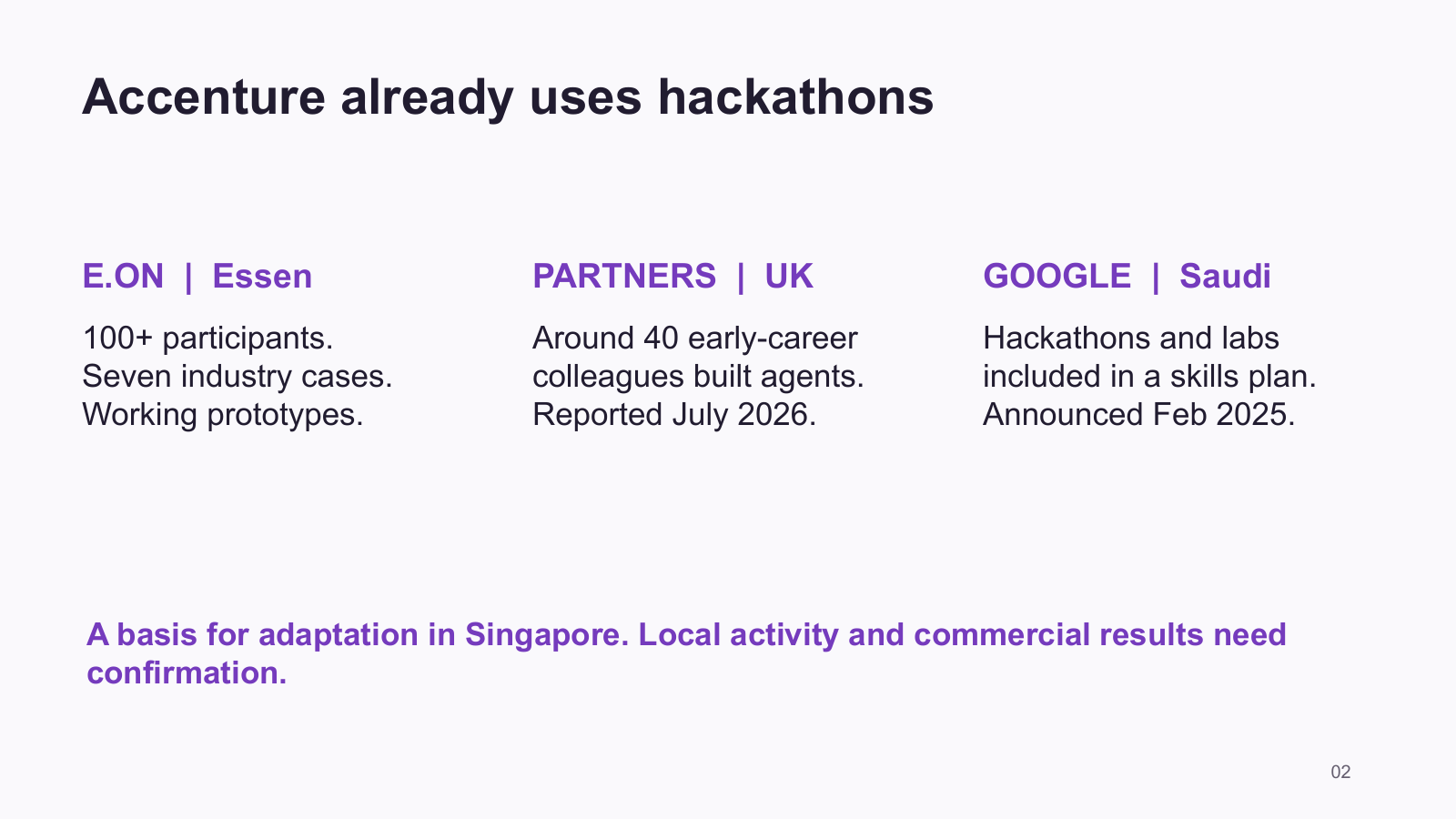
Slide 2 · Accenture already uses hackathons
- E.ON | Essen
- 100+ participants. Seven industry cases. Working prototypes.
- PARTNERS | UK
- Around 40 early-career colleagues built agents. Reported July 2026.
- GOOGLE | Saudi
- Hackathons and labs included in a skills plan. Announced Feb 2025.
A basis for adaptation in Singapore. Local activity and commercial results need confirmation.
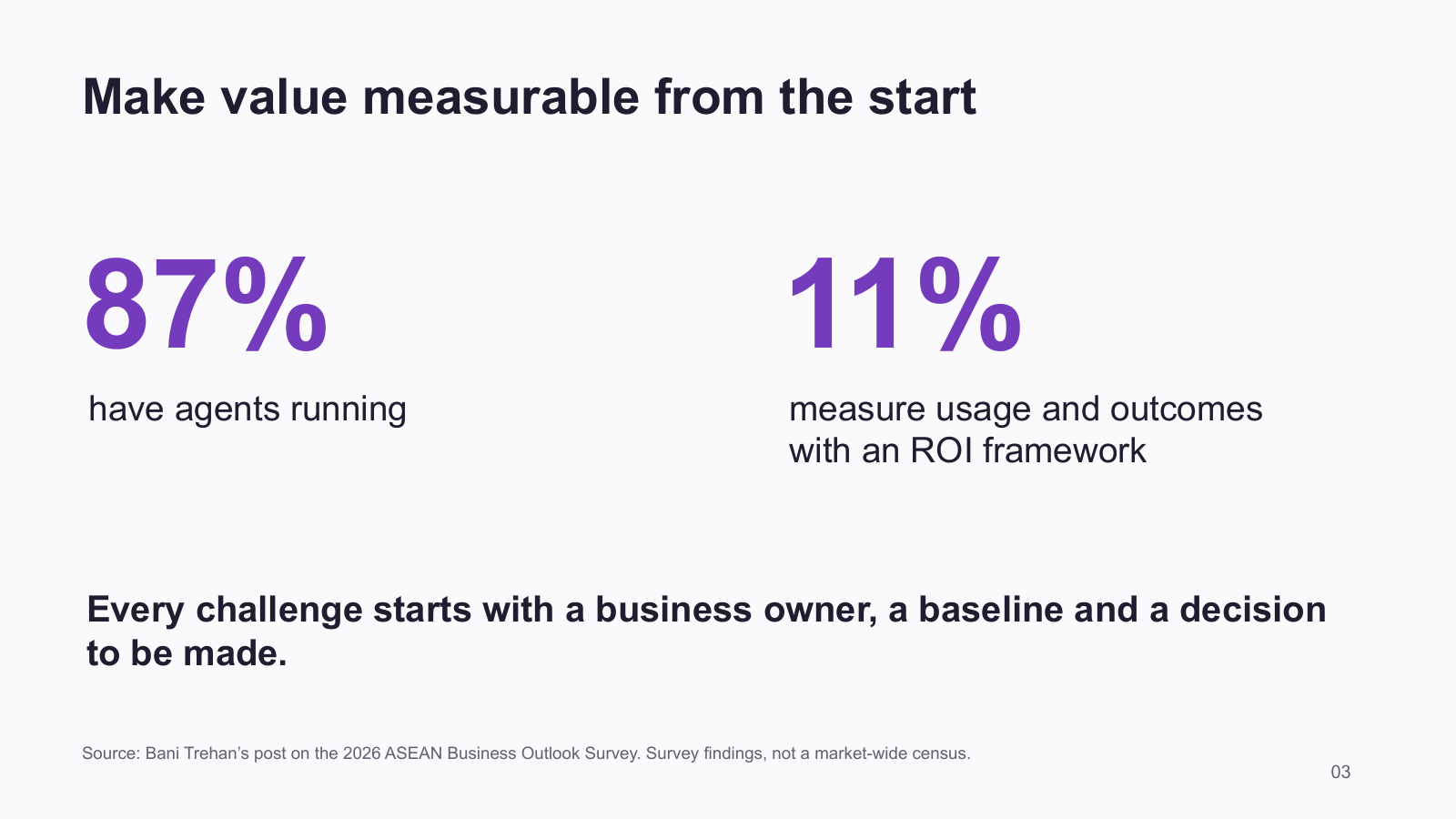
Slide 3 · Make value measurable from the start
- 87%
- have agents running
- 11%
- measure usage and outcomes with an ROI framework
Every challenge starts with a business owner, a baseline and a decision to be made.
Source: Bani Trehan’s post on the 2026 ASEAN Business Outlook Survey. Survey findings, not a market-wide census.
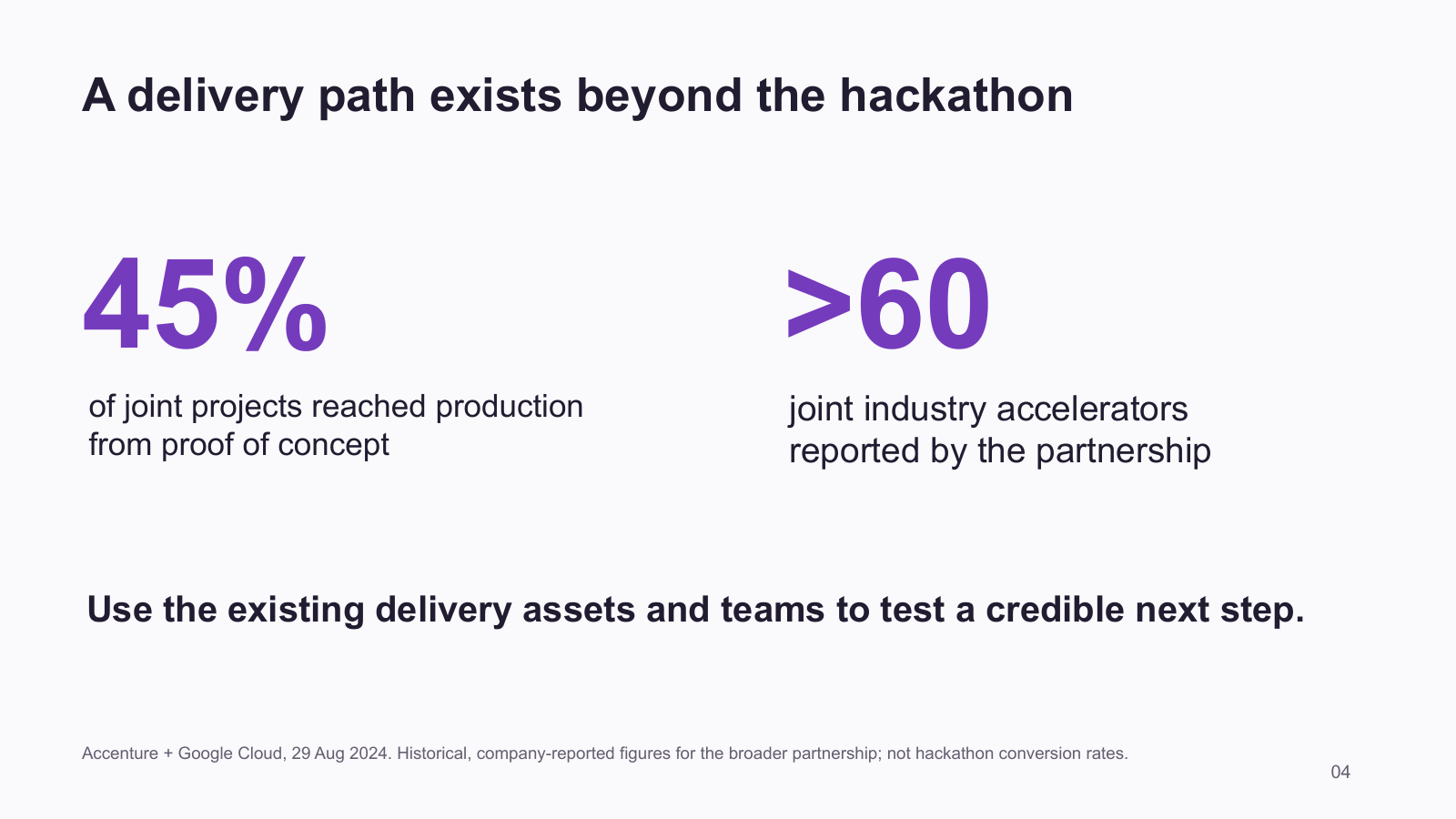
Slide 4 · A delivery path exists beyond the hackathon
- 45%
- of joint projects reached production from proof of concept
- >60
- joint industry accelerators reported by the partnership
Use the existing delivery assets and teams to test a credible next step.
Accenture + Google Cloud, 29 Aug 2024. Historical, company-reported figures for the broader partnership; not hackathon conversion rates.
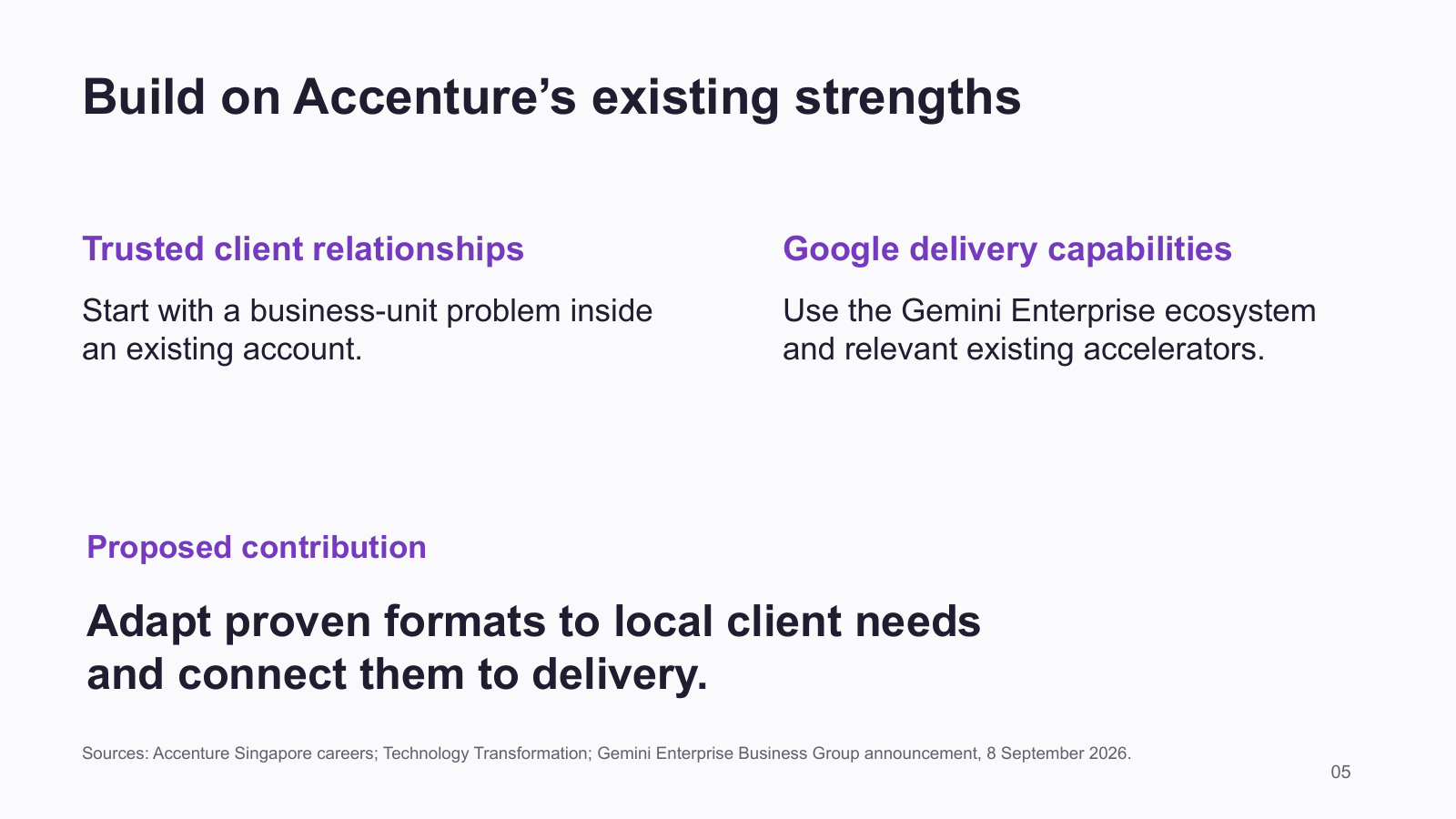
Slide 5 · Build on Accenture’s existing strengths
- Trusted client relationships
- Start with a business-unit problem inside an existing account.
- Google delivery capabilities
- Use the Gemini Enterprise ecosystem and relevant existing accelerators.
- Proposed contribution
- Adapt proven formats to local client needs and connect them to delivery.
Sources: Accenture Singapore careers; Technology Transformation; Gemini Enterprise Business Group announcement, 8 September 2026.
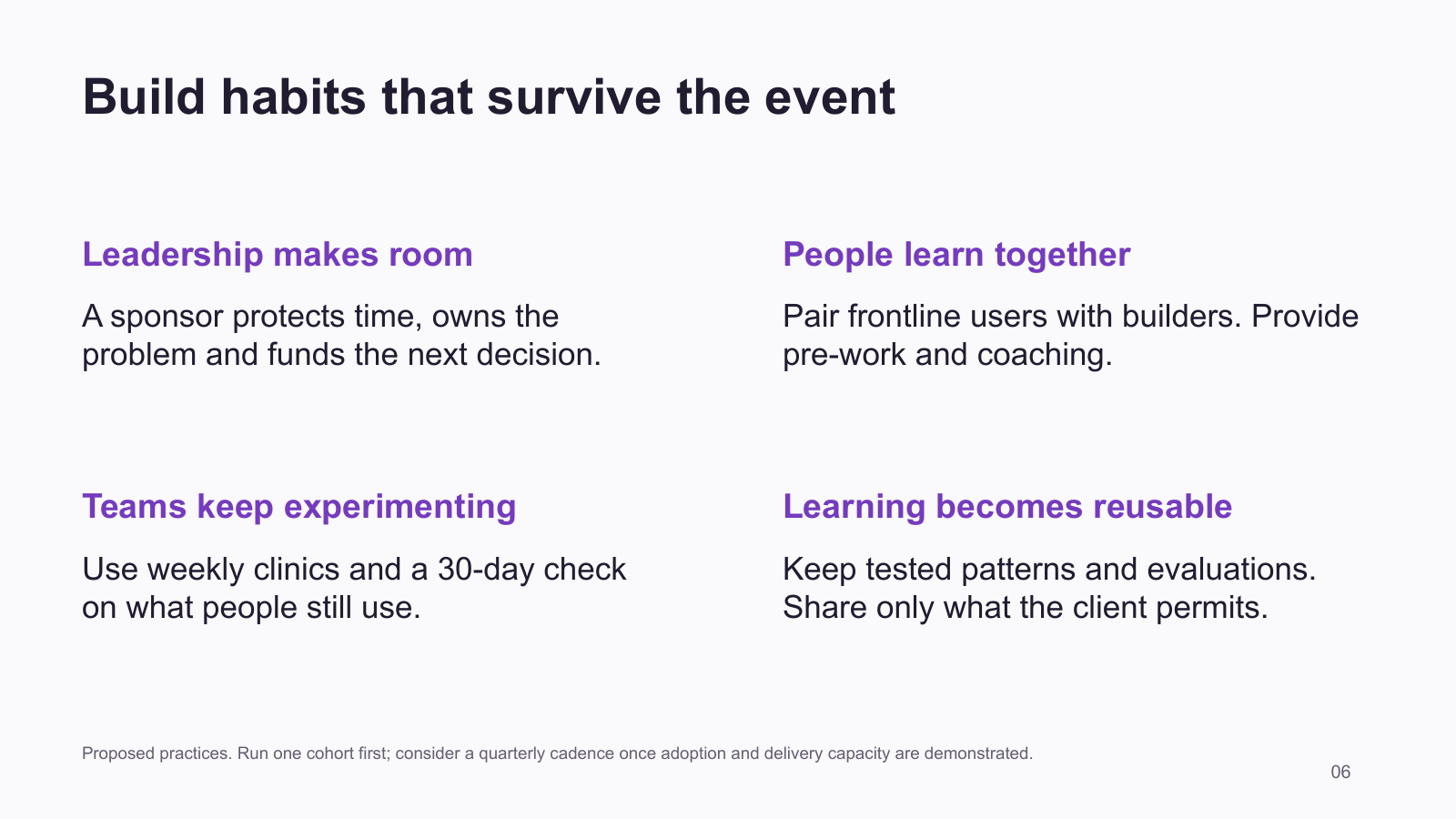
Slide 6 · Build habits that survive the event
- Leadership makes room
- A sponsor protects time, owns the problem and funds the next decision.
- People learn together
- Pair frontline users with builders. Provide pre-work and coaching.
- Teams keep experimenting
- Use weekly clinics and a 30-day check on what people still use.
- Learning becomes reusable
- Keep tested patterns and evaluations. Share only what the client permits.
Proposed practices. Run one cohort first; consider a quarterly cadence once adoption and delivery capacity are demonstrated.
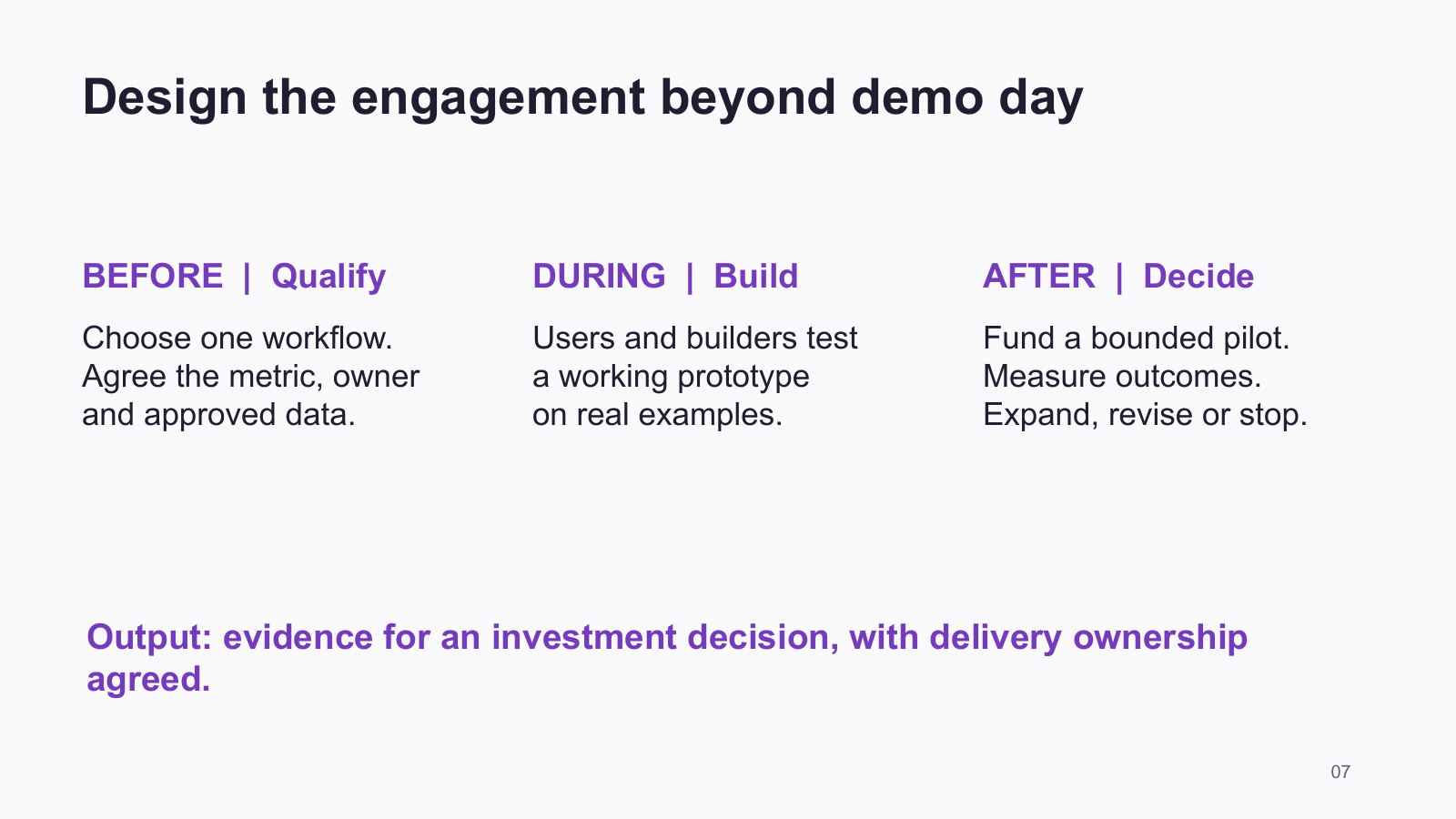
Slide 7 · Design the engagement beyond demo day
- BEFORE | Qualify
- Choose one workflow. Agree the metric, owner and approved data.
- DURING | Build
- Users and builders test a working prototype on real examples.
- AFTER | Decide
- Fund a bounded pilot. Measure outcomes. Expand, revise or stop.
Output: evidence for an investment decision, with delivery ownership agreed.
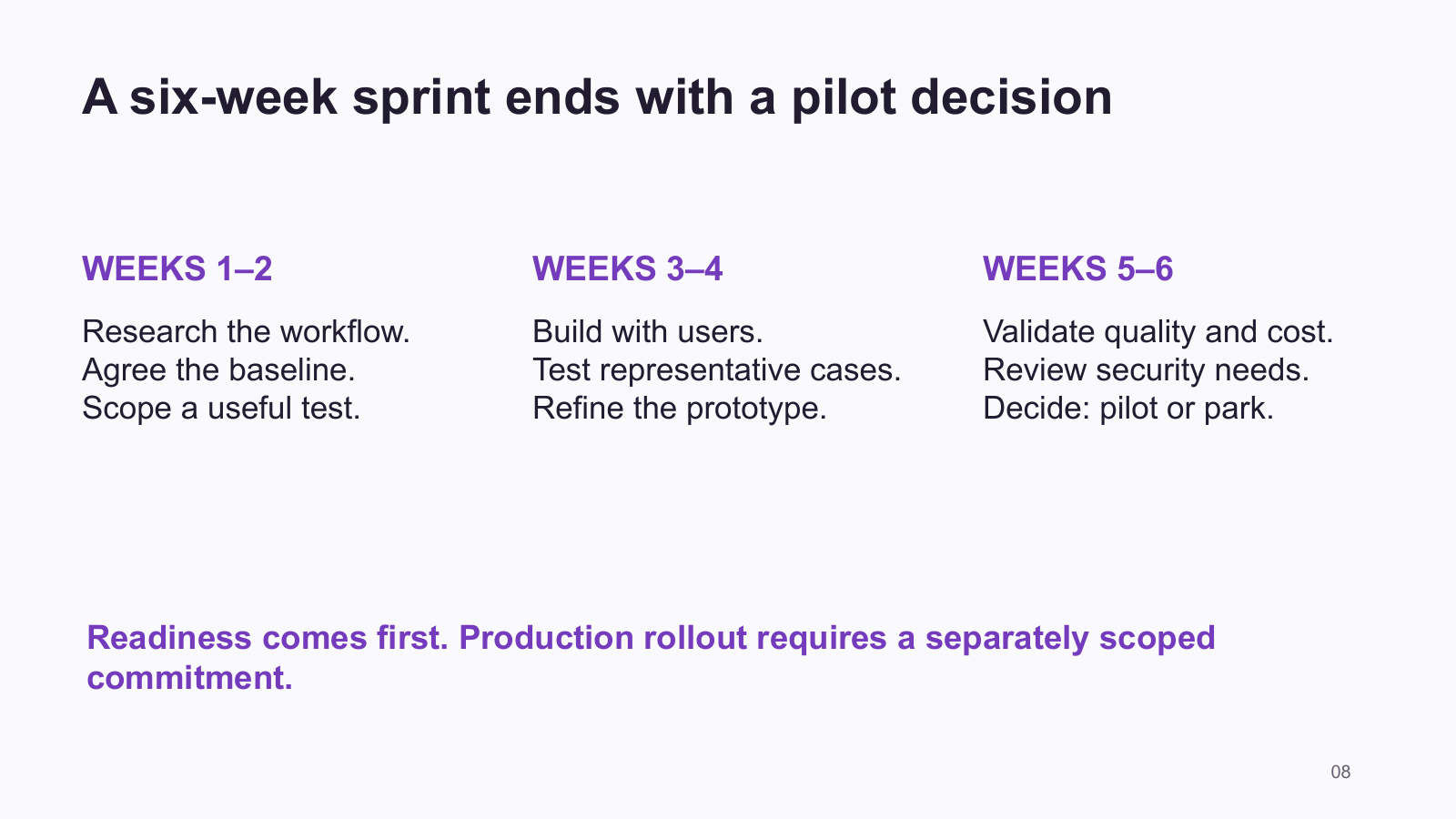
Slide 8 · A six-week sprint ends with a pilot decision
- WEEKS 1–2
- Research the workflow. Agree the baseline. Scope a useful test.
- WEEKS 3–4
- Build with users. Test representative cases. Refine the prototype.
- WEEKS 5–6
- Validate quality and cost. Review security needs. Decide: pilot or park.
Readiness comes first. Production rollout requires a separately scoped commitment.
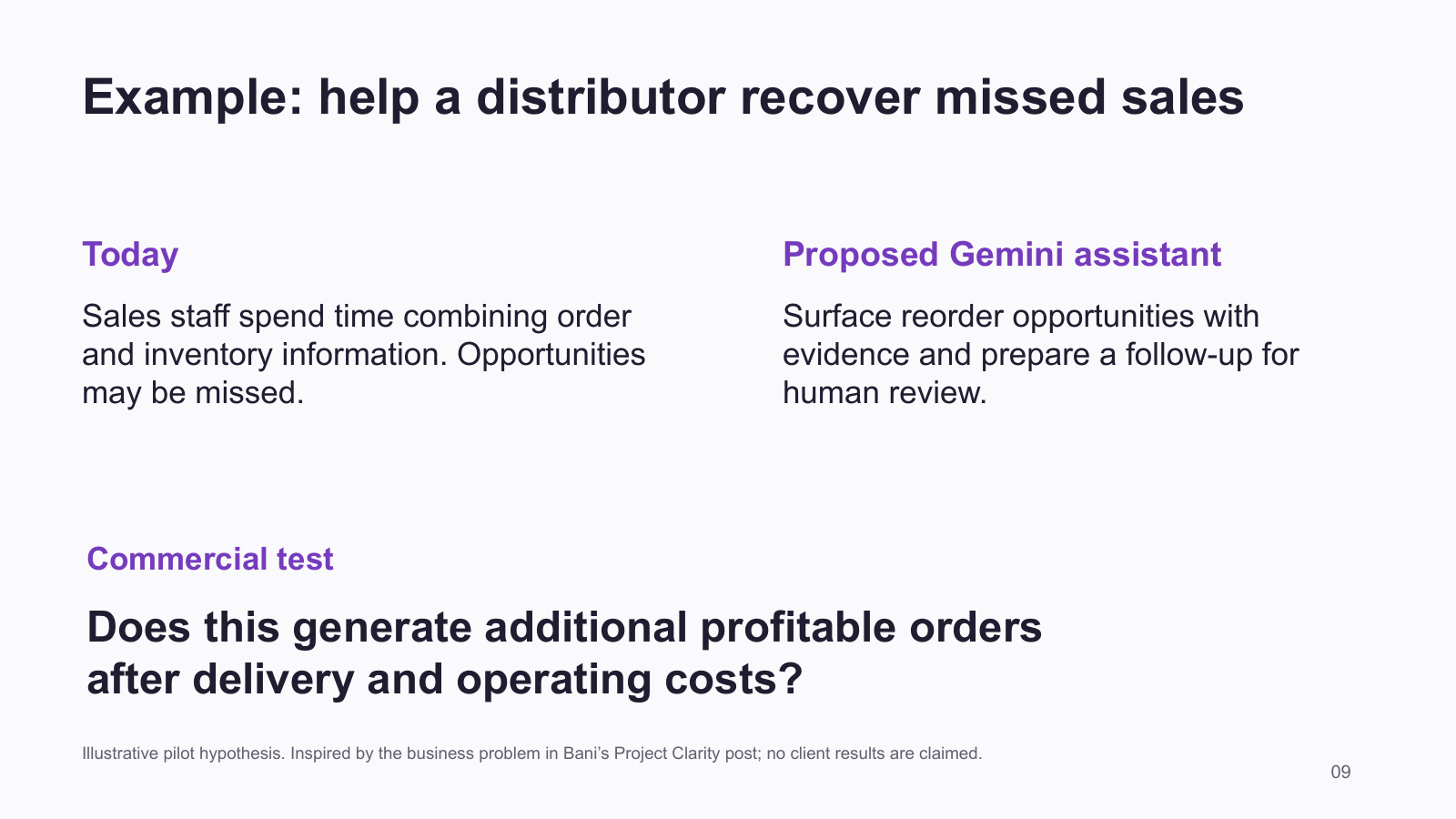
Slide 9 · Example: help a distributor recover missed sales
- Today
- Sales staff spend time combining order and inventory information. Opportunities may be missed.
- Proposed Gemini assistant
- Surface reorder opportunities with evidence and prepare a follow-up for human review.
- Commercial test
- Does this generate additional profitable orders after delivery and operating costs?
Illustrative pilot hypothesis. Inspired by the business problem in Bani’s Project Clarity post; no client results are claimed.
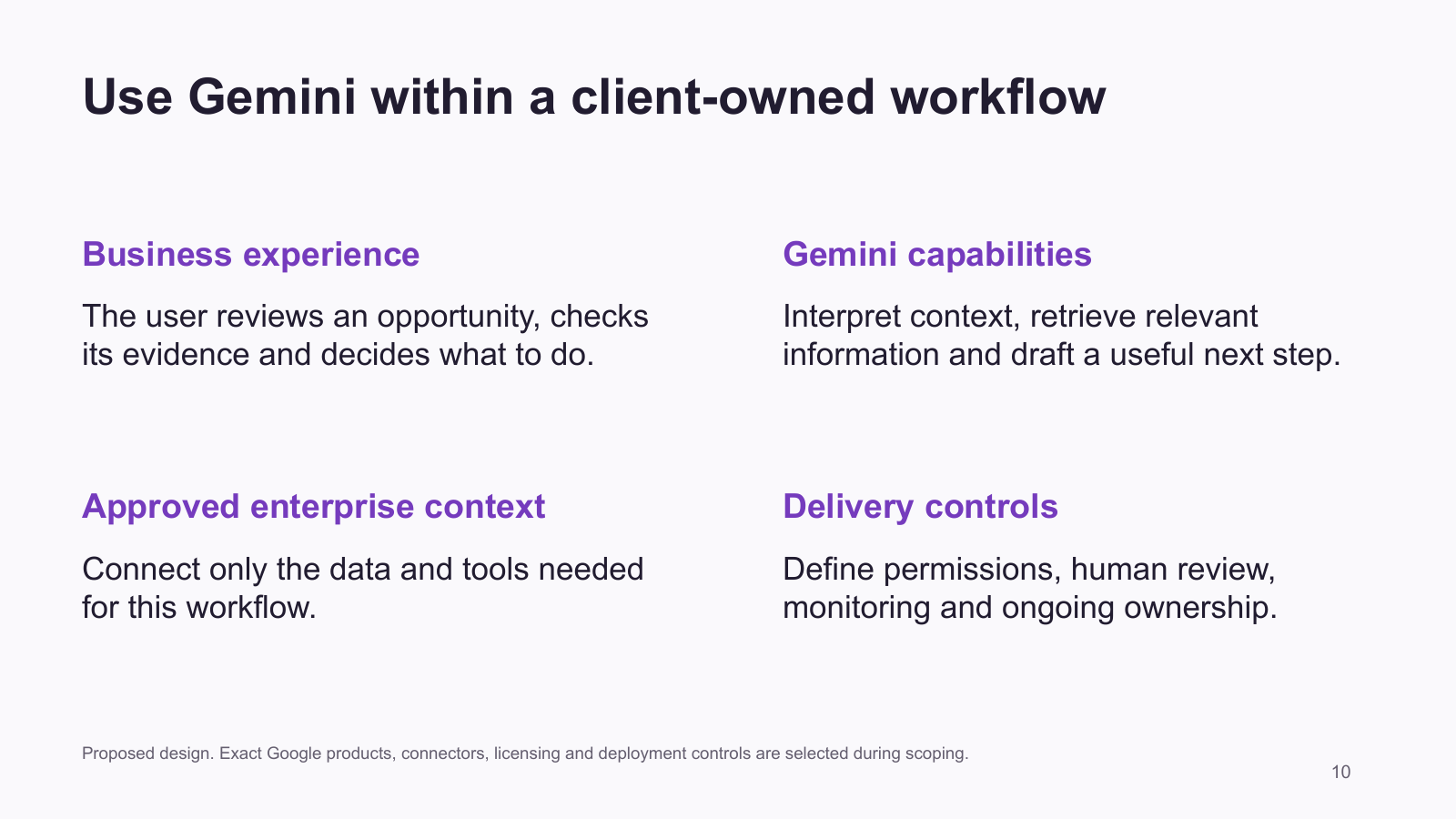
Slide 10 · Use Gemini within a client-owned workflow
- Business experience
- The user reviews an opportunity, checks its evidence and decides what to do.
- Gemini capabilities
- Interpret context, retrieve relevant information and draft a useful next step.
- Approved enterprise context
- Connect only the data and tools needed for this workflow.
- Delivery controls
- Define permissions, human review, monitoring and ongoing ownership.
Proposed design. Exact Google products, connectors, licensing and deployment controls are selected during scoping.
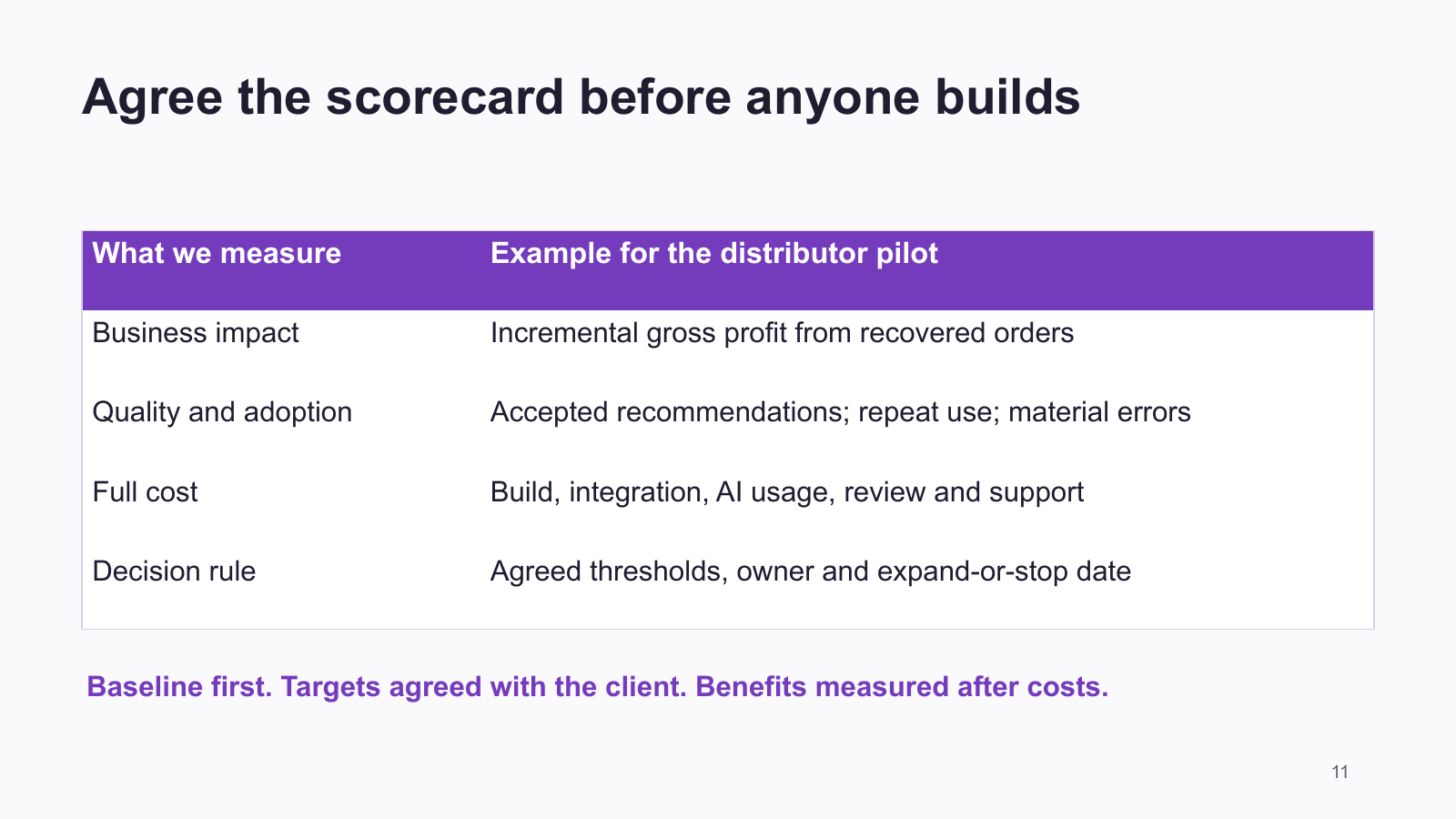
Slide 11 · Agree the scorecard before anyone builds
| What we measure | Example for the distributor pilot |
|---|---|
| Business impact | Incremental gross profit from recovered orders |
| Quality and adoption | Accepted recommendations; repeat use; material errors |
| Full cost | Build, integration, AI usage, review and support |
| Decision rule | Agreed thresholds, owner and expand-or-stop date |
Baseline first. Targets agreed with the client. Benefits measured after costs.
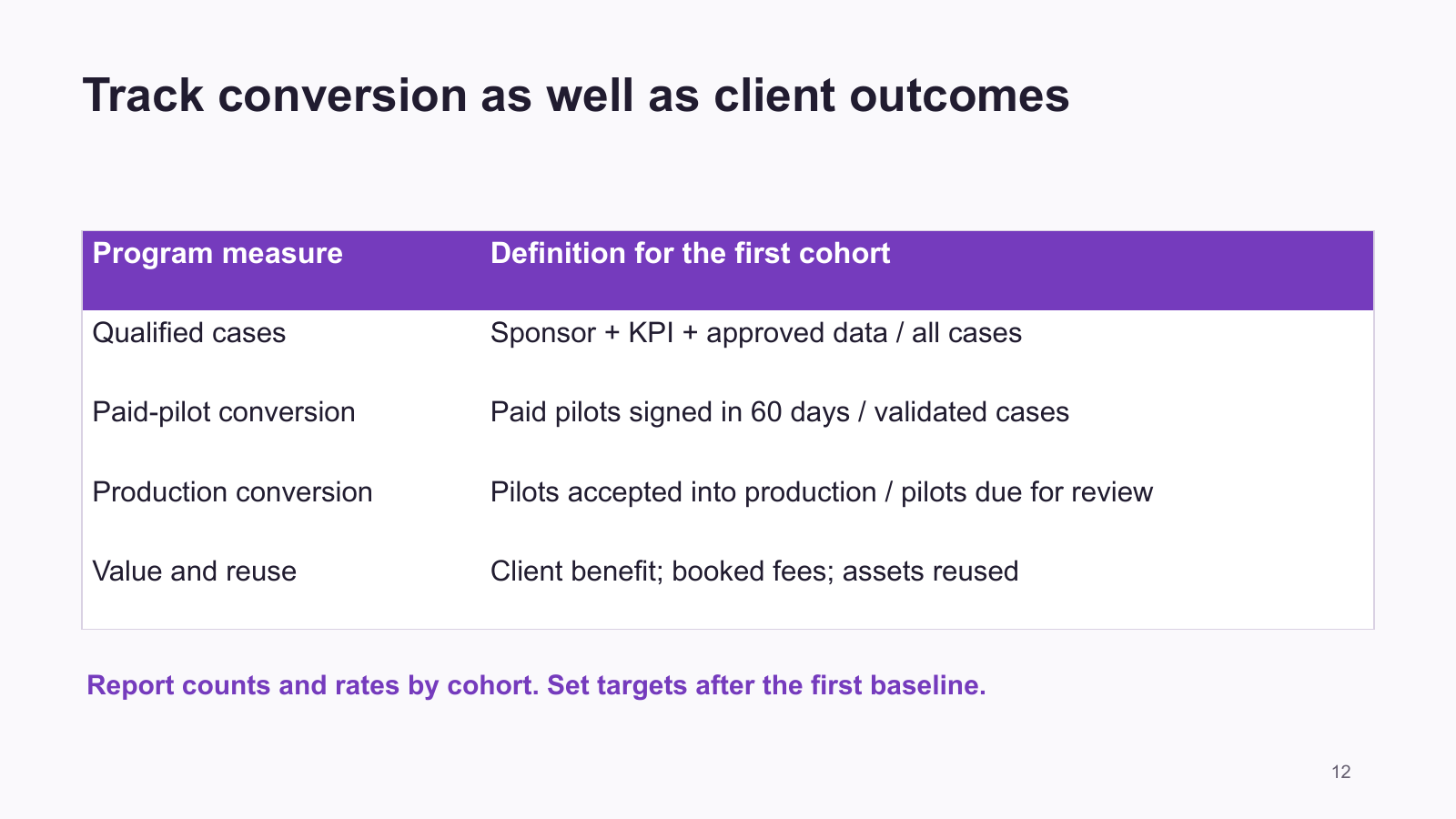
Slide 12 · Track conversion as well as client outcomes
| Program measure | Definition for the first cohort |
|---|---|
| Qualified cases | Sponsor + KPI + approved data / all cases |
| Paid-pilot conversion | Paid pilots signed in 60 days / validated cases |
| Production conversion | Pilots accepted into production / pilots due for review |
| Value and reuse | Client benefit; booked fees; assets reused |
Report counts and rates by cohort. Set targets after the first baseline.
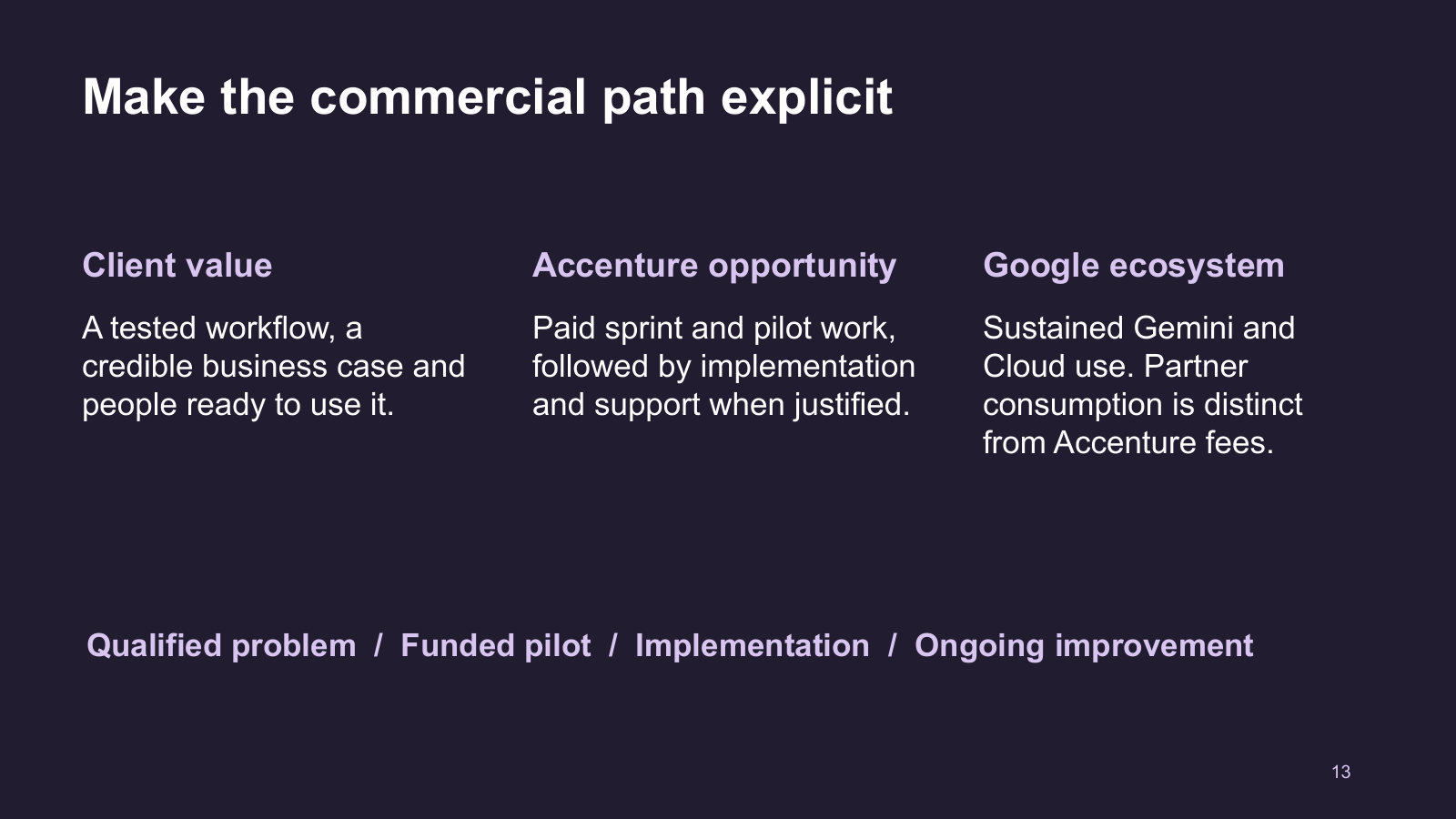
Slide 13 · Make the commercial path explicit
- Client value
- A tested workflow, a credible business case and people ready to use it.
- Accenture opportunity
- Paid sprint and pilot work, followed by implementation and support when justified.
- Google ecosystem
- Sustained Gemini and Cloud use. Partner consumption is distinct from Accenture fees.
Qualified problem / Funded pilot / Implementation / Ongoing improvement
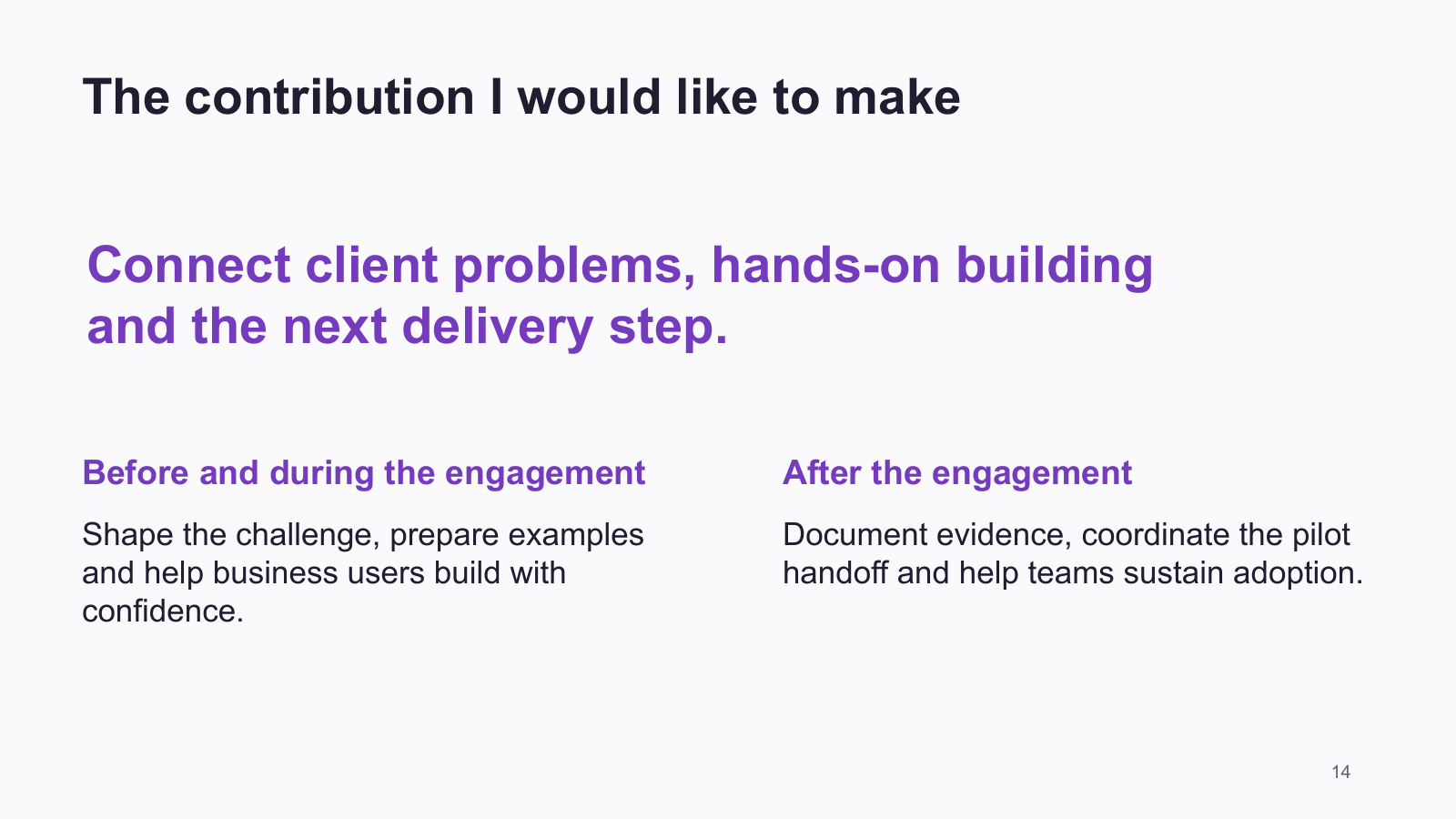
Slide 14 · The contribution I would like to make
Connect client problems, hands-on building and the next delivery step.
- Before and during the engagement
- Shape the challenge, prepare examples and help business users build with confidence.
- After the engagement
- Document evidence, coordinate the pilot handoff and help teams sustain adoption.
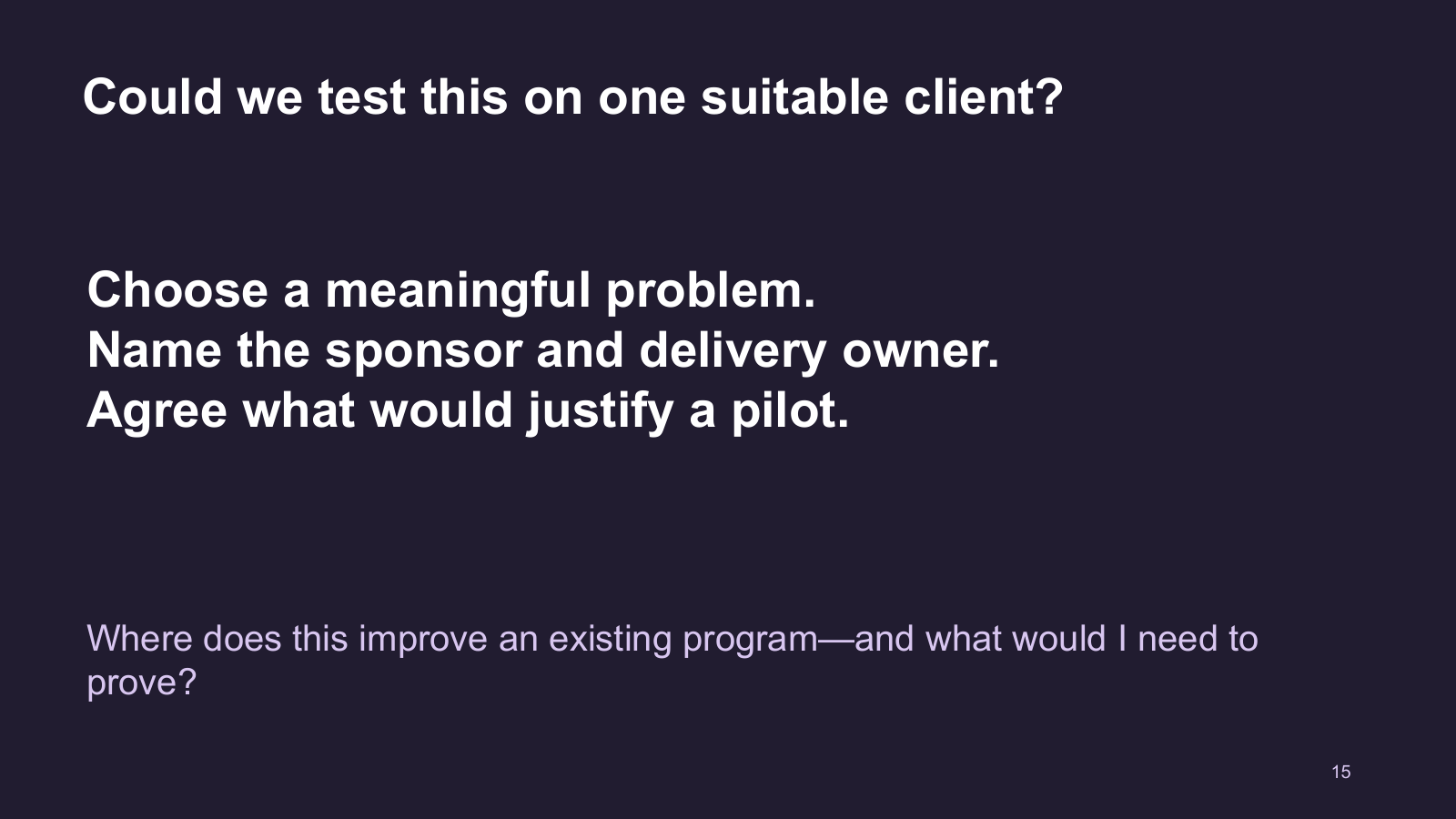
Slide 15 · Could we test this on one suitable client?
Choose a meaningful problem.
Name the sponsor and delivery owner.
Agree what would justify a pilot.
Where does this improve an existing program—and what would I need to prove?
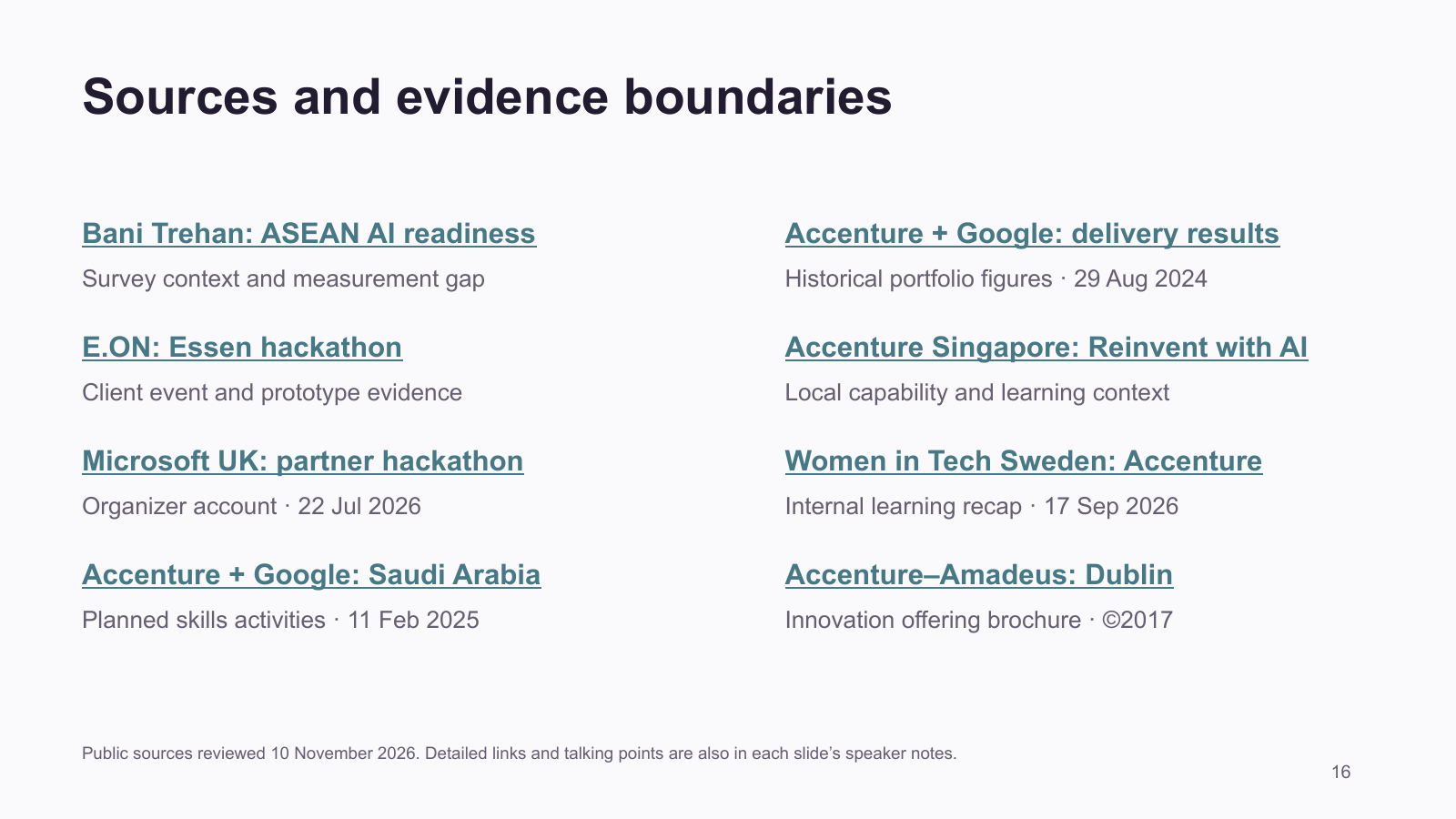
Slide 16 · Sources and evidence boundaries
- Bani Trehan: ASEAN AI readiness
- Survey context and measurement gap
- E.ON: Essen hackathon
- Client event and prototype evidence
- Microsoft UK: partner hackathon
- Organizer account · 22 Jul 2026
- Accenture + Google: Saudi Arabia
- Planned skills activities · 11 Feb 2025
- Accenture + Google: delivery results
- Historical portfolio figures · 29 Aug 2024
- Accenture Singapore: Reinvent with AI
- Local capability and learning context
- Women in Tech Sweden: Accenture
- Internal learning recap · 17 Sep 2026
- Accenture–Amadeus: Dublin
- Innovation offering brochure · ©2017
Public sources reviewed 10 November 2026. Detailed links and talking points are also in each slide’s speaker notes.
Recurring buildathons
A monthly buildathon
for client teams
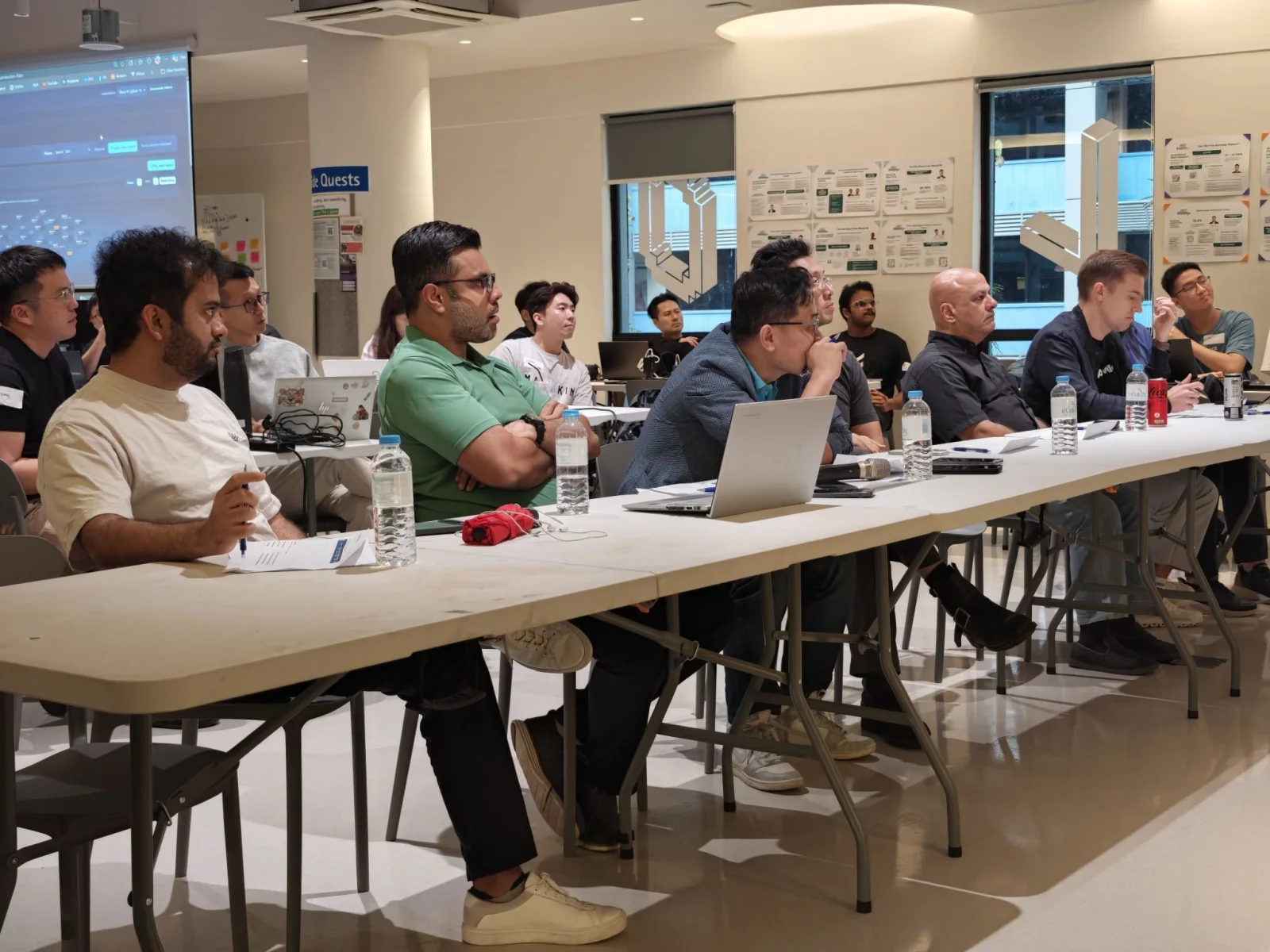
Bani attended the recent mini build session at Open Government Products (OGP), where OpenAI was the main sponsor. That evening is the model for this series.
Each buildathon gives people time to try one workflow, show what they made and get feedback. A month later, we can ask what they still use and which idea deserves a client pilot.
The buildathon calendar
-
Event guide ↗
ElevenLabs at Grab
Voice AI and creative agents at Grab HQ, one-north. More than 600 signed up on Luma.
-
Session details ↗
Supabase at Temus
A hands-on build session with short demos, time to build and feedback from other makers.
-
Temporal ↗
Temporal buildathon
Planned for Singapore. Venue to be confirmed.
-
Runpod ↗
Runpod buildathon
Planned for Singapore. Venue to be confirmed.
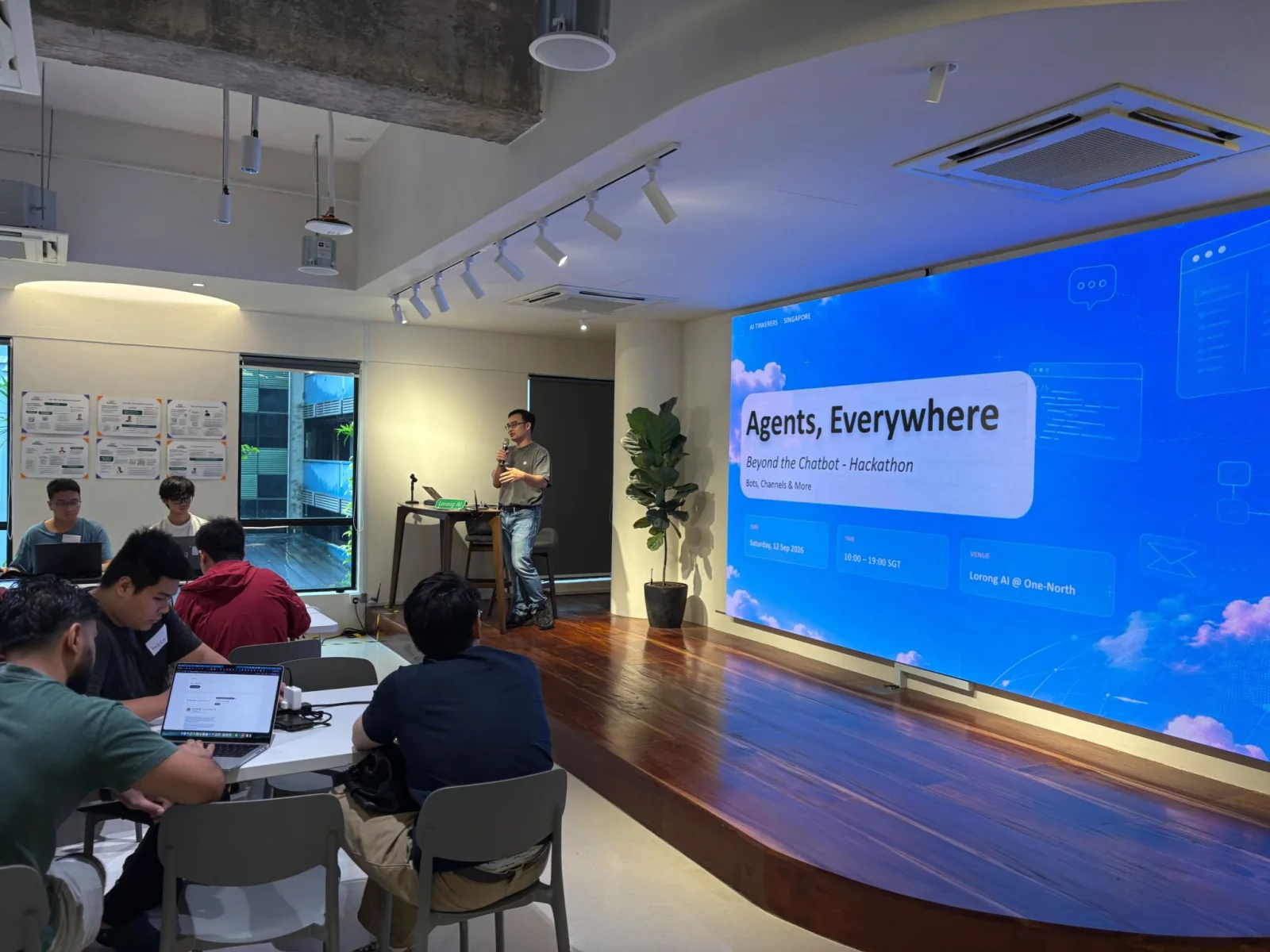
Singapore · 12 September 2026
Agents, Everywhere
at Lorong AI
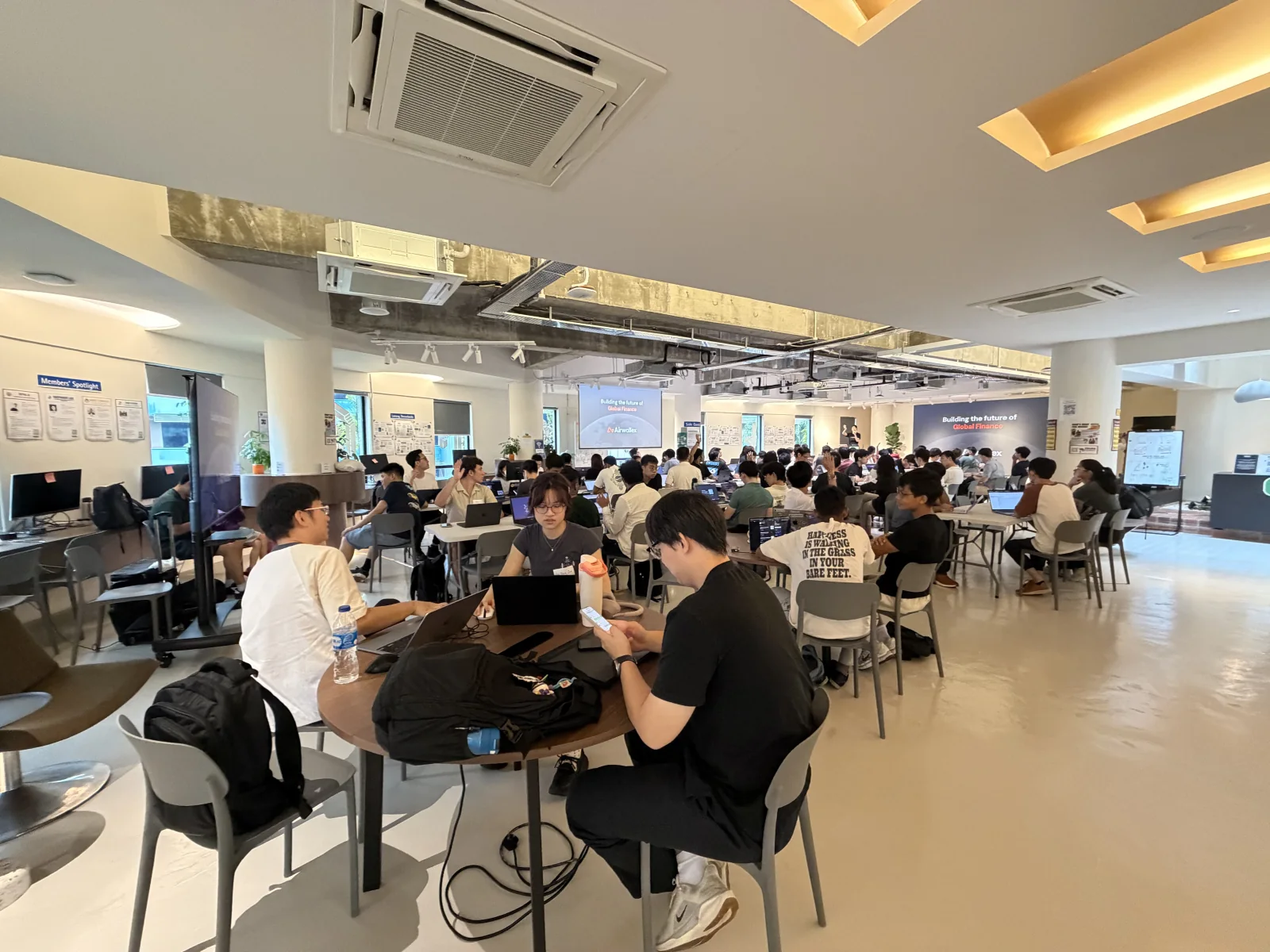
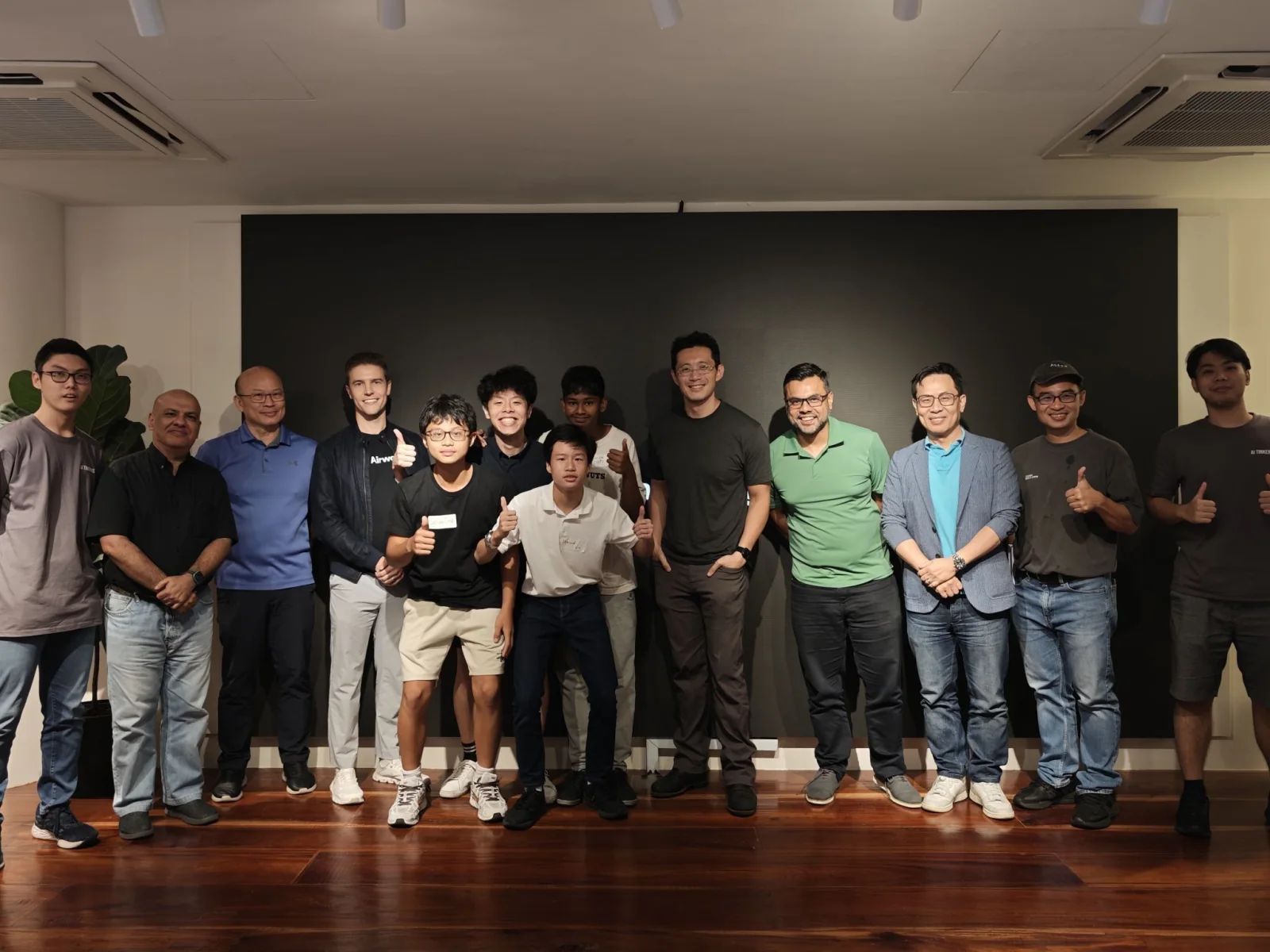
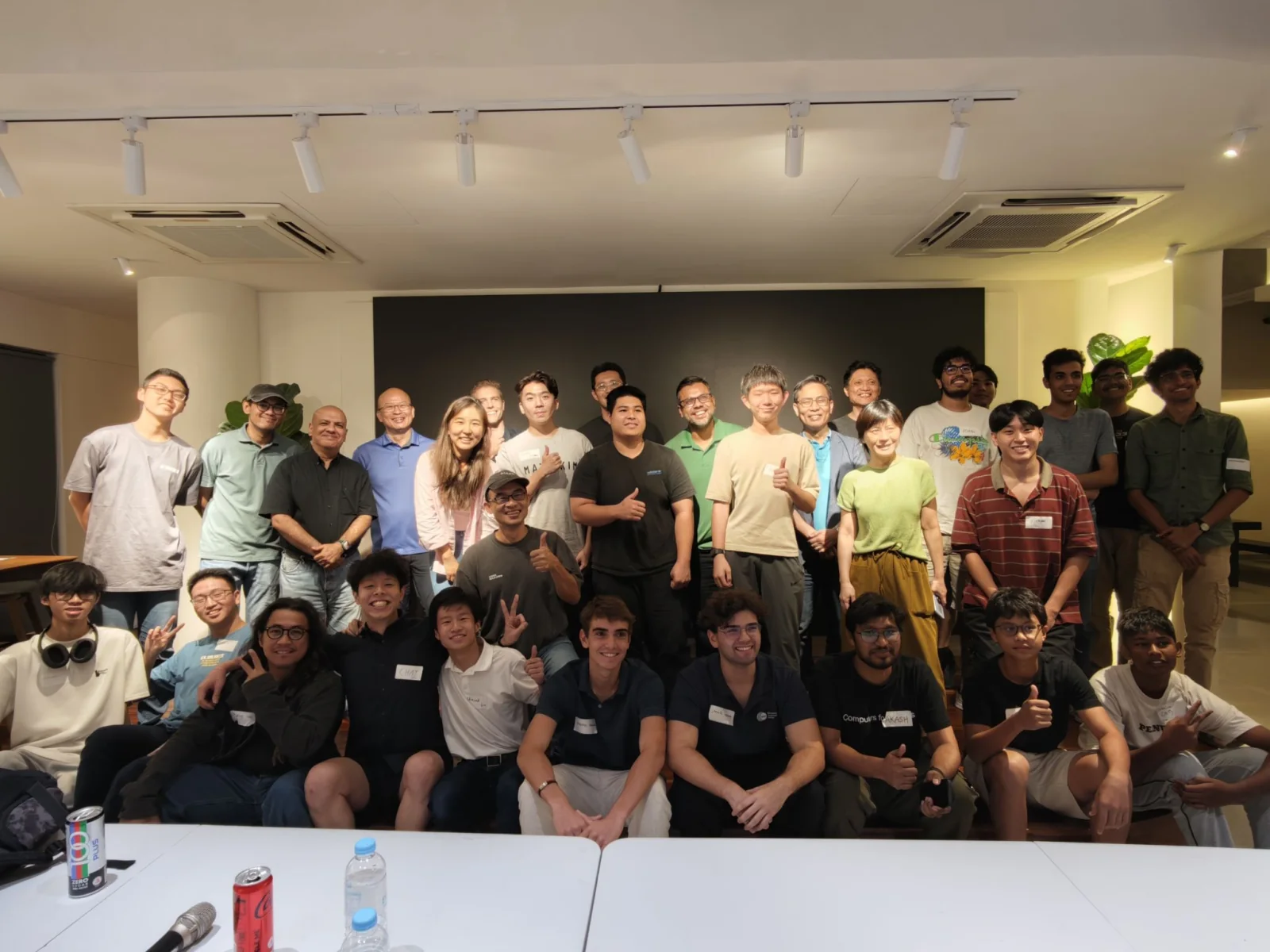
I hosted the Singapore edition of Agents, Everywhere at Lorong AI. OpenAI was the global marquee sponsor. Teams built agents for the channels people already use. Their public showcase features 34 projects and 14 demo videos.
Judges included
- Sai Visesh SureshForward-deployed engineering manager, OpenAI.
- JJ (Projjal) GhatakCEO and co-founder of OnLoop at the hackathon. Now Google Cloud’s GTM Lead for Japan and Asia Pacific.
- Li HongyiSenior Director, Open Government Products, Singapore.
Explore the projects and demos ↗ Event programme and sponsors ↗
Infographic
The enterprise hackathon framework
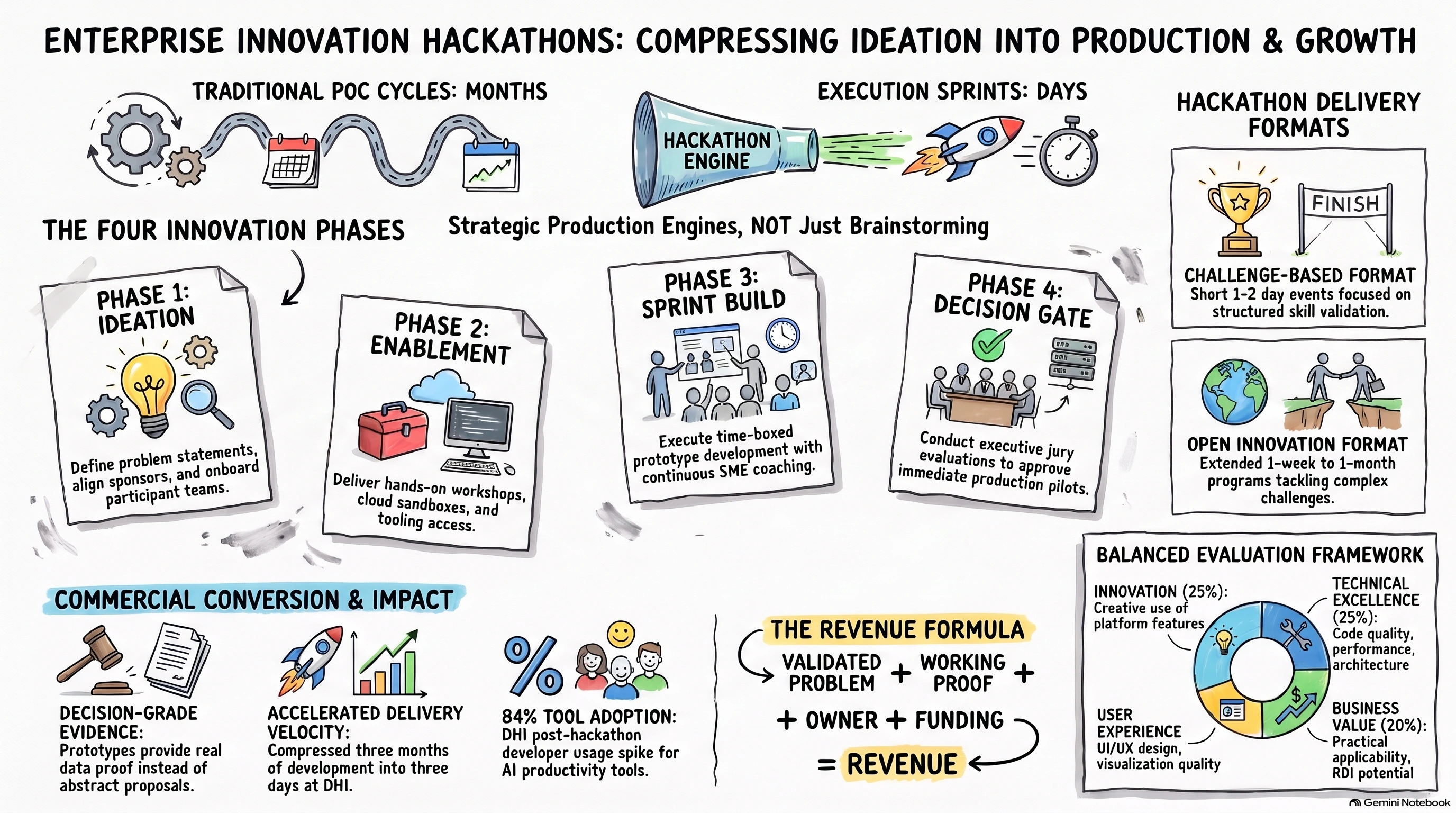
A note on the figures. The artwork’s scoring chart differs from the Snowflake–Accenture event rubric. The published weights are 30% innovation, 25% technical excellence, 25% business value and 20% user experience. AWS reports the 84% figure as an increase in Kiro usage at DHI after the hackathon.
Read the infographic as text
The illustration compares a conventional proof of concept that takes months with a concentrated build sprint measured in days. It shows four phases.
- Ideation. Define the problem, agree on sponsors and bring the teams together.
- Enablement. Give participants hands-on training, a cloud sandbox and access to their tools.
- Sprint build. Develop a prototype within a fixed time, with subject-matter experts on hand.
- Decision. An executive panel reviews the evidence and decides which prototypes merit a pilot.
A challenge-based format uses one or two days to practise and test a defined skill. An open innovation format gives teams a week to a month to explore a more complex problem.
The commercial sequence combines a validated problem, working proof, a named owner and funding for the next step. The DHI example illustrates speed and tool uptake. AWS reports that teams built functioning features in three days and validated the architecture. The judging criteria used in the Snowflake example appear above.
Original NotebookLM infographic ↗Enterprise Hackathons: Compressing AI Innovation into Production and Revenue
How can a client tell whether an AI prototype deserves funding? This report follows the work from an initial business problem through user testing, executive review and a possible paid pilot.
Introduction
Imagine an executive deciding whether to fund a multimillion-dollar AI programme. A 50-page proposal can describe the opportunity. A three-day hackathon can let the people doing the work try the idea on a real example and show the executive what happened.
The business case for an enterprise hackathon depends on what that test establishes. Is the problem important to the client? Can the team make the approach work with approved data? Who would own and fund the next stage?
Questions the report examines
- How can evidence from a prototype lead to a funded consulting engagement?
- When does a guided challenge suit the objective, and when do teams need an open innovation format?
- What happens in each of the four phases from preparation to a pilot decision?
- What did DHI Group and AWS build, and how did Snowflake and Accenture judge the business value of submissions?
How a prototype can lead to funded work
A working example reduces some of the uncertainty in a large investment decision. A sponsor can watch frontline users test the prototype on an approved sample of company data, see which assumptions hold, and decide whether a pilot justifies the expense. Four pieces of work contribute to that decision.
- Frame the problem. Identify one workflow, measure the difficulty users experience, and name an executive sponsor. Discovery may reveal process changes that would help alongside the technology.
- Build a working prototype. Test whether the proposed design works with representative data and cloud infrastructure. Document which architectural assumptions held up and which need further testing.
- Validate it with users. Ask frontline employees to try realistic tasks and show where the workflow breaks down. Their feedback identifies design changes, training needs and barriers to adoption.
- Make the business case. Estimate the potential return, identify gaps in legacy systems, and scope the integration and delivery work a pilot would require.
The report expresses its commercial hypothesis as consulting revenue = validated problem + working proof + named owner + funded next step. In practice, the first three give a sponsor grounds to consider the fourth. Fees depend on the work the client actually commissions.
Schedule the decision before the build begins. Each prototype should leave the review with a business owner, a primary metric, a review date and a proposed scope for a limited pilot. The sponsor can then fund that scope, request further evidence or close the case.
Delivery formats, infrastructure and the four phases
Start with the organisation’s objective. CloudLabs describes two delivery formats. The AWS Hackathon Acceleration Package gives a separate example of how to organise the work around an enterprise use case.
Challenge-based hackathons. These one- or two-day events use guided scenarios, instructions and automated validation. They suit skills development, developer productivity and quick technical checks. Examples include GitHub Copilot adoption and Azure OpenHack challenges.
Open innovation hackathons. Cross-functional teams design their own solutions to a broader challenge, such as modernising an application or integrating generative AI. Programmes can run from one week to one month. A jury evaluates the teams’ work and selects ideas for further development. CloudLabs’ comparison of the two formats.
The report identifies four operational phases.
- Preparation and ideation. Define the business problem, secure an executive sponsor and agree the judging criteria. Brief participants, register them and form teams.
- Enablement. Run targeted workshops and tool training before the event. Check access in advance so teams can begin building on the first day.
- Build and collaboration. Provide isolated cloud sandboxes, approved data and an agreed resource allowance, such as Azure credits or AWS resources. Arrange technical support for the duration of the build, including overnight coverage for a 24-hour event, and put subject-matter experts within reach of teams.
- Evaluation and the path to production. Use a published scoring matrix, recognise strong submissions and hold the sponsor review. For selected work, identify the security, scaling and integration tasks that stand between the prototype and production.
Case studies from DHI Group, AWS, Snowflake and Accenture
DHI Group and AWS
DHI Group wanted to accelerate development of generative AI features for its talent acquisition business. Using the AWS Hackathon Acceleration Package, it brought together 20 people in three cross-functional teams for a three-day build. Senior DHI leaders evaluated the prototypes on the final day.
The winning team connected ClearanceJobs with AgileATS. Its prototype let a recruiter ask, in ordinary language, for security-cleared software engineers with relevant GitHub experience. An agent running on Amazon Bedrock AgentCore used the Model Context Protocol (MCP) to call search and profile tools. AWS Lambda functions retrieved candidate records and enriched them with GitHub profile data.
AWS and DHI report that the teams built working features in three days that they would typically expect to take more than three months. They validated the architecture during the event and agreed on further hardening and integration. After the event, Kiro usage across DHI’s product and engineering teams increased by 84%. AWS and DHI’s architecture and results.
Snowflake and Accenture
The partners organised a virtual hackathon with an in-person finale in Bangalore. Teams could tackle vehicle quality, telecom network operations or retail challenges using tools such as Snowflake Cortex AI, Python and Streamlit. The published rubric made the relative importance of each criterion explicit.
| Criterion | Weight | What the jury assessed |
|---|---|---|
| Innovation | 30% | Original use of the platform’s capabilities. |
| Technical excellence | 25% | Code quality, architecture and performance. |
| Business value | 25% | Practical applications and potential return on investment. |
| User experience | 20% | Interface design and the clarity of visualisations. |
The two examples address different decisions. DHI leaders could inspect a working recruiter workflow and commit resources to taking it further. Snowflake and Accenture gave teams and judges a common way to compare the merits of their submissions. Snowflake’s programme and official judging rubric.
Summary
An enterprise hackathon can compress technical exploration into a short build and give a client evidence for a funding decision. Getting from that decision to a rollout takes an owner, a budget and a delivery team.
- Evidence. Ask users to try the prototype on representative data and capture the results a sponsor will need to judge feasibility and value.
- Commercial follow-through. Connect the validated problem and working proof to a named owner and an explicitly funded next step.
- Format. Use a one- or two-day guided challenge for skills validation. Give an open innovation team one week to one month when it needs to develop and test a solution.
- Readiness. Prepare the people and cloud environment in advance, include users and technical specialists on the team, and bring decision-makers into the review to choose what proceeds.
Download the original report text ↓ Open the original NotebookLM report ↗